
Purpose of the flight and payload description
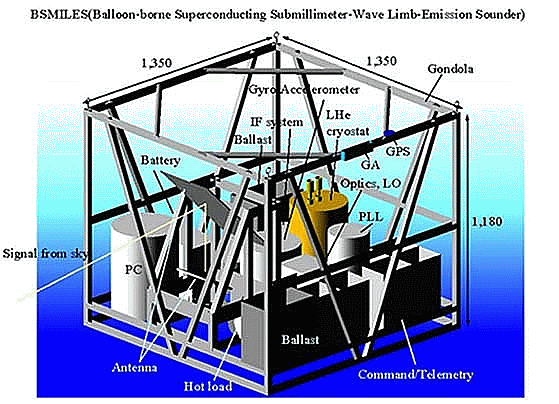
The instrument was designed to observe stratospheric ozone and another minor constituents which will play important role for ozone depletion.
Emission line spectra from these species in the submillimeter-wave range is observed by using low noise superconducting receiver (SIS: Superconductor-Insulator-Superconductor mixer).
BSMILES observes stratospheric molecules in the altitude range from 10 to 35 km with the vertical resolution of about 1 km and data accuracy of 10%.
In this second flight a improved version of the system was flown to observe other spectra than in the first flight.
Details of the balloon flight
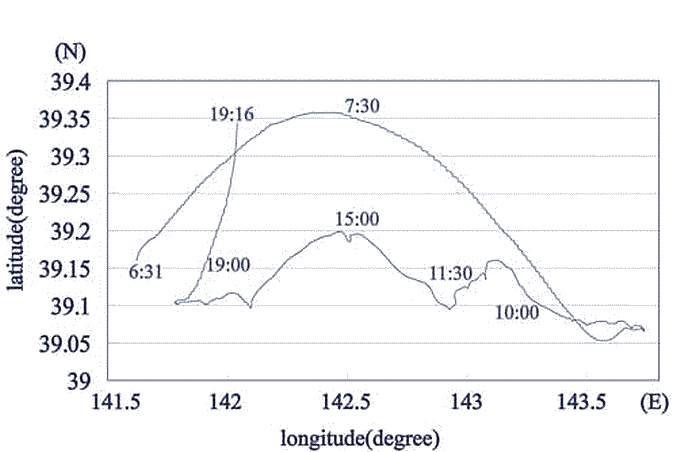
Balloon launched on: 9/7/2004 at 6:30 jst
Launch site: Sanriku Balloon Center, Iwate, Japan
Balloon launched by: Institute of Space and Astronautical Science (ISAS) / Japan Aerospace Exploration Agency (JAXA)
Balloon manufacturer/size/composition: Zero Pressure Balloon model B100 100.000 m3
Flight identification number: B100-12
End of flight (L for landing time, W for last contact, otherwise termination time): 9/7/2004
Balloon flight duration (F: time at float only, otherwise total flight time in d:days / h:hours or m:minutes - ): ~ 6 h
Landing site: In the sea at 142º14'E - 39º21'N
Payload weight: 490 kgs
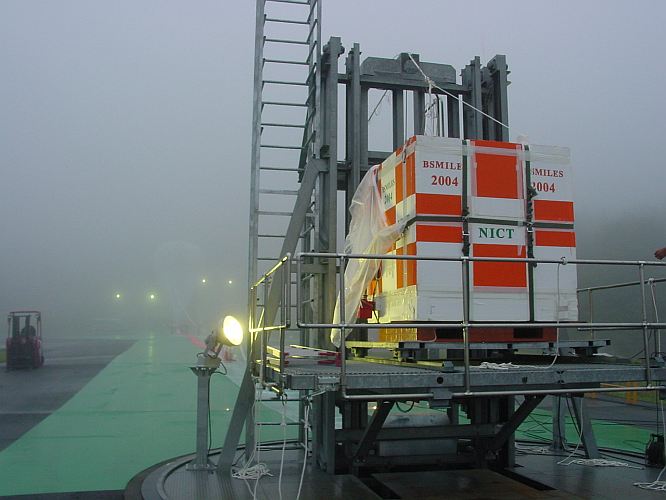
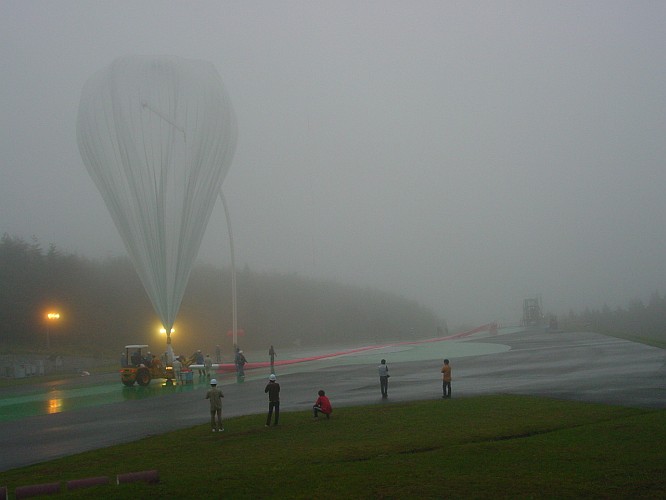
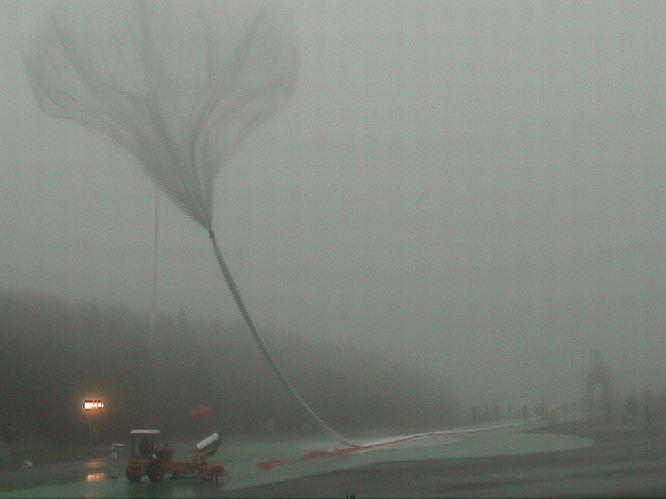
The launch took place at 6:30 using vertical inflation technique in a foggy morning on September 7th.
After a smooth launch headed east and at 9:45 leveled at floating altitude of 35.2km.
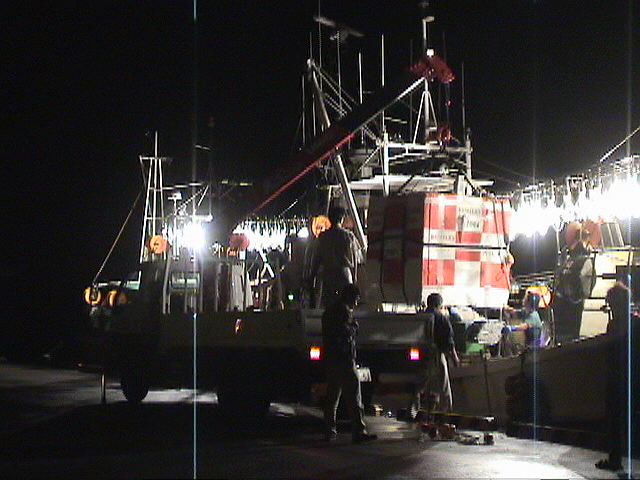
When finished the scientific observations the payload was cut down at 142º14'E - 39º21'N and landed by parachute in the sea and later was retrieved by the rescue vessel without damage.
External references
- Ballooning activities in Japan Advances in Space Research 42 (2008) 1619
- Baloon SMILES at National Institute of Information and Communications Technology website
- BSMILES - A Balloon-Borne Superconducting Submillimeter-Wave Limb-Emission Sounder Journal of the National Institute of Information and Communications Technology Vol.54 Nos.1/2
- ISAS press release JAXA website
Images of the mission
StratoCat is an independent, non-commercial project maintained to preserve and share the history of scientific and stratospheric ballooning. If you find the site useful, you can help keep it running with a small donation toward its operating costs. Every contribution, even the equivalent of a cup of coffee, is greatly appreciated.