Purpose of the flight and payload description
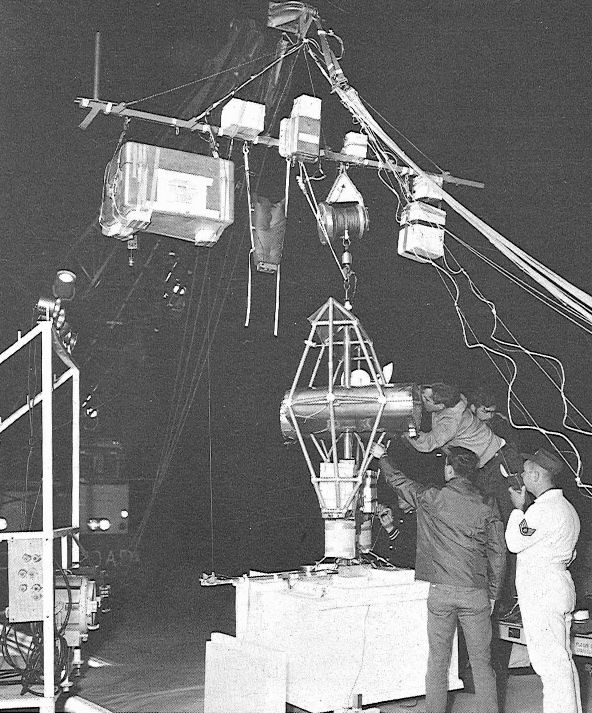
The payload was composed by a solar-oriented, high-energy neutron detector of the proton-recoil type.
The aim of the flight was to investigate solar neutrons. These studies included measurements of the neutron albedo of the earth and detection of neutrons from solar flares. Measurements of the earths albedo neutron flux, studies of models for neutron production in the atmosphere, and measurements of high energy atmospheric neutrons also form a part of the program.
A total of four flights were performed between 1963 and 1964 at Holloman Air Force Base in New Mexico.
In the image at left we can see the instrument flown during pre-flight preparations. A similar detector has been flown on a NASA Orbiting Solar Observatory, OSO-G in 1969
Details of the balloon flight
Balloon launched on: 6/2/1964
Launch site: Holloman Air Force Base, Alamogordo, New Mexico, US
Balloon launched by: Air Force Cambridge Research Laboratories (AFCRL)
Balloon manufacturer/size/composition: Zero Pressure Balloon 2.940.000 cuft (1.5 mil)
End of flight (L for landing time, W for last contact, otherwise termination time): 6/3/1964
Balloon flight duration (F: time at float only, otherwise total flight time in d:days / h:hours or m:minutes - ): 28 h
Landing site: 12 miles SSE of Ray, Arizona, US
Payload weight: 928.5 pds
External references
- Physics & Astronomy 1971/72 Brochure. The University of New Mexico, Albuquerque (via Archive.Org)
- Summary of Balloon Flights launched from H.A.F.B. NM (1962 thru 1987) U.S. Gov. National Archives
- The Flight Record Scientific Ballooning Nº 16, September 1964
StratoCat is an independent, non-commercial project maintained to preserve and share the history of scientific and stratospheric ballooning. If you find the site useful, you can help keep it running with a small donation toward its operating costs. Every contribution, even the equivalent of a cup of coffee, is greatly appreciated.