
Purpose of the flight and payload description
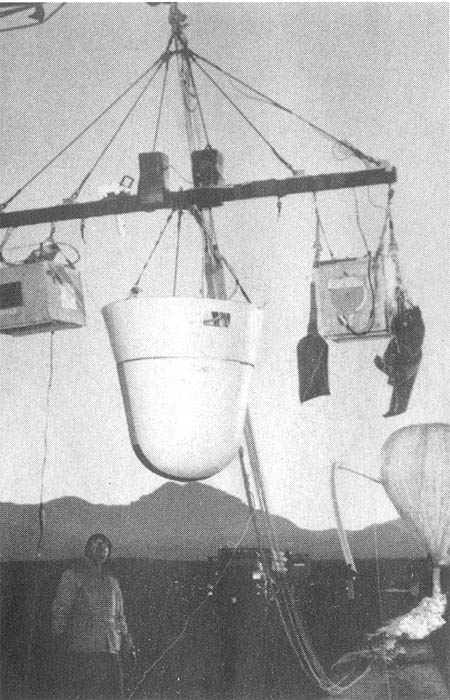
The objective of the flight was to perform a stratospheric drop test of a DISCOVERER satellite nosecone to evaluate the parachute and retrofiring systems of a capsule intended to reenter from orbit. DISCOVERER was a program started in 1958 presented to the public as a scientific project aimed at developing and acquiring biomedical data on animals, but its real purpose was to provide a cover story for the highly classified CORONA photoreconnaissance satellite program, designed to obtain images of Soviet and Chinese strategic military assets. The program was part of a complex effort directed by multiple agencies and involving various military and civilian contractors, including the U.S. Air Force, the Air Force Systems Command (AFSC), the Air Force Ballistic Missile Division (AFBMD), and the Central Intelligence Agency (CIA). General Electric (GE) supplied the recovery system for the capsules, including the thermal protection, retrorocket, and attitude control system.
During 1959 and 1960, the Discoverer program attempted ten orbital capsule recoveries, all unsuccessful. Seeking to address the failures, it was decided to test the problematic components by dropping a replica of the satellite nosecone from a stratospheric balloon reproducing every step of the recovery procedure. Originally planned for nine drops during April and May 1960 at Holloman Air Force Base in New Mexico, the program was expanded to a total of 31 drops, concluding with the final test in February 1961.
At left we can see a close-up of the test capsule and the telemetry equipment that provided flight data and received the release command. The equipment varied over time according to the specific test performed or the modifications introduced as the program advanced. For each test, the capsule (equipped with telemetry systems to monitor performance) was carried by a stratospheric balloon to about 100,000 feet and then released inside a fairing similar to that of the AGENA vehicle, simulating the critical re-entry and recovery phases. During the retrofiring system drop, an internal ejection programmer activated the spin system, the retrorocket, and the de-spin system in the correct sequence, and it also controlled the parachute deployment. The test capsules were fully instrumented to track internal performance and transmitted data to ground stations, accurately reproducing the Mach and dynamic loading conditions encountered during actual aerial recoveries.
Details of the balloon flight
Balloon launched on: 4/5/1960
Launch site: Holloman Air Force Base, Alamogordo, New Mexico, US
Balloon launched by: Balloon Branch, Holloman Air Force Base (HAFB)
Balloon manufacturer/size/composition: Zero Pressure Balloon General Mills 2.940.000 cuft (1.5 Mils. Taped)
Flight identification number: HAFB Nº 1118
End of flight (L for landing time, W for last contact, otherwise termination time): 4/5/1960
Landing site: In the White Sands Missile Range, New Mexico, US
Overall weight: 1924 lbs
This first series of drop tests carried out in April 1960, forced a delay of the launch of the Discoverer XI from Vandenberg AFB, California. The rocket firing sequence was put into a hold pending results of the balloon tests. The balloon was launched succesfully in April 5th, but the test failed due to a parachute malfunction. The test would be repeated three days later this time with success.
External references
- Balloon Branch Record U.S. National Archives
- The Roswell Report: Case Closed James McAndrews, Headquarters United States Air Force, 1997 pag. 156 - 158
If you consider this website interesting or useful, you can help me to keep it up and running with a small donation to cover the operational costs. Just the equivalent of the price of a cup of coffee helps a lot.