
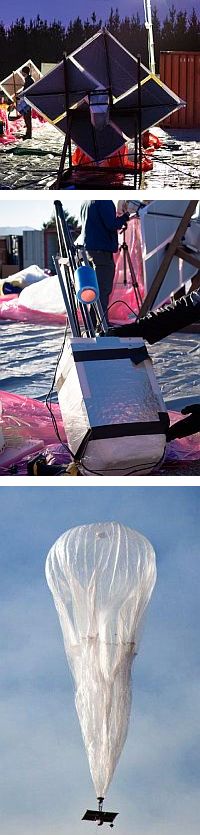
 LOON project
Project Loon was an experimental telecommunications program developed by Google X, later X, with the objective of providing broadband Internet connectivity to remote and underserved regions through fleets of autonomous high-altitude balloons operating in the lower stratosphere at altitudes between approximately 18 and 25 km. Conceived in 2011 under the leadership of Mike Cassidy, the project sought to overcome the limitations of conventional terrestrial infrastructure by creating an airborne LTE network capable of communicating directly with standard mobile devices. Following preliminary engineering work in California, the program was publicly announced in June 2013 after a series of successful prototype flights.
The first public flight campaign took place in New Zealand, where approximately thirty balloons demonstrated the feasibility of delivering Internet connectivity from the stratosphere. Early experiments focused on validating balloon endurance, communications systems and navigation concepts. During the following years, the project evolved into a complete airborne telecommunications platform integrating lightweight solar-powered payloads, rechargeable batteries, LTE base stations, flight computers, satellite positioning systems and autonomous parachute recovery systems. The balloon envelopes were designed and manufactured by Raven Aerostar, a division of Raven Industries based in Sioux Falls, South Dakota, which developed successive generations of customized superpressure polyethylene balloons optimized for long-duration stratospheric flight and large-scale production. The collaboration continued throughout the lifetime of the program and later resulted in the transfer of part of Loon's balloon manufacturing intellectual property to Raven Aerostar after the project's closure.
A fundamental engineering challenge was navigation without propulsion. Rather than employing engines, each balloon controlled its altitude by pumping air into or out of an internal ballonet, allowing it to enter stratospheric wind layers moving in different directions. Autonomous flight software combined atmospheric forecasting with machine-learning algorithms to determine the sequence of altitude changes required to move individual balloons toward assigned positions or maintain continuous network coverage. As the system matured, balloons operated as elements of a coordinated fleet rather than as independent vehicles, automatically repositioning themselves to compensate for changing winds and replacing balloons reaching the end of their operational lives.
Communications architecture also advanced significantly. Each balloon functioned as an LTE base station connected to neighboring balloons through high-capacity radio links, forming an aerial mesh network that routed data to ground stations connected to the terrestrial Internet. Later development introduced free-space optical communication using laser links between balloons separated by tens of kilometers, greatly increasing inter-balloon bandwidth while reducing dependence on radio-frequency spectrum. The optical communications technology developed during the program later became the foundation of Project Taara.
Flight operations expanded steadily beyond the initial New Zealand demonstrations. In 2014 the project successfully established LTE connections directly between stratospheric balloons and conventional mobile telephones during trials in Brazil, confirming compatibility with existing cellular standards without requiring specialized user equipment. During subsequent years additional flight campaigns were conducted in New Zealand, Australia, Argentina, Chile, Brazil, Peru, Sri Lanka, Indonesia, Kenya and the United States as navigation algorithms, communications systems and balloon endurance continued to improve.
As operational capability increased, Loon established two permanent launch facilities with distinct functions. Research and development launches were conducted primarily from Winnemucca Municipal Airport in Nevada, where new balloon designs, communications hardware, navigation software and launch procedures were evaluated through relatively short-duration flights over the continental United States. Operational launches were based at José Aponte de la Torre Airport in Ceiba, Puerto Rico, where favorable tropical stratospheric wind patterns enabled balloons to enter long-duration circulation for missions over Latin America, the Caribbean, Africa and other regions. Both launch sites employed highly automated launch equipment capable of inflating, assembling and releasing balloons at regular intervals with minimal human intervention, substantially increasing operational efficiency and safety.
The project also demonstrated the value of stratospheric communications during natural disasters. Following severe flooding in Peru in 2017, balloons restored damaged communications infrastructure in isolated regions. Later that year, after Hurricane Maria destroyed much of Puerto Rico's cellular network, Loon collaborated with local telecommunications operators to provide temporary LTE coverage for hundreds of thousands of residents while terrestrial infrastructure was repaired. These emergency deployments represented the first large-scale operational use of stratospheric balloons as temporary telecommunications platforms.
In July 2018 Loon graduated from X and became an independent subsidiary of Alphabet, reflecting its transition from an experimental research effort to an operational telecommunications company. Balloon production, autonomous fleet management and launch operations were increasingly automated, while improvements in envelope materials, power systems and flight software substantially extended mission duration. In 2019 the balloon fleet surpassed one million cumulative flight hours in the stratosphere, and a single balloon established a program endurance record by remaining airborne for 312 consecutive days before recovery in Mexico following launch from Puerto Rico.
Commercial service began in 2020 through a partnership with Telkom Kenya, making Loon the first high-altitude balloon system to provide regular LTE Internet service to commercial customers using standard mobile telephones. During the same year the company became a founding member of the High Altitude Platform Station Alliance, established to promote international standards and accelerate the development of high-altitude communication platforms.
Although the project demonstrated the technical feasibility of long-duration autonomous balloon operations and airborne LTE networks, the economic model proved difficult to sustain. In January 2021 Alphabet announced that Loon would cease operations because the costs of providing service remained too high to achieve long-term commercial viability in its target markets. Commercial service in Kenya continued temporarily while the program was wound down and flight operations were progressively terminated.
Following the closure of the project, Loon undertook an extensive effort to preserve its technical legacy. More than 200 patents were released under a non-assertion pledge, engineering documentation and operational experience were published as the Loon Collection, and technologies developed during the program, particularly free-space optical communications, were transferred to Project Taara for continued development. In July 2021 the company also published its complete operational stratospheric sensor dataset through the Zenodo open-data repository. The collection contained GPS position, altitude, pressure, temperature and related atmospheric measurements acquired by the balloon fleet between 2019 and 2021, constituting one of the largest publicly available in situ datasets obtained from long-duration stratospheric balloon operations and providing a valuable resource for atmospheric science, numerical weather prediction and high-altitude platform research.
During approximately a decade of development, Project Loon became one of the largest and most sophisticated stratospheric balloon programs ever undertaken. Thousands of balloons were manufactured and launched, collectively accumulating more than one million flight hours while repeatedly circumnavigating the Earth and traveling many millions of kilometers through the lower stratosphere. The program established routine autonomous navigation using atmospheric winds, demonstrated balloon lifetimes exceeding 300 days, pioneered large-scale airborne LTE networking and inter-balloon laser communications, restored telecommunications after major natural disasters, and became the first high-altitude balloon system to deliver commercial Internet service. Although commercial operations ended in 2021, Project Loon significantly advanced the state of the art in long-duration superpressure balloons, autonomous fleet management, stratospheric communications and high-altitude platform systems, leaving a technological and scientific legacy that continued to influence subsequent developments in atmospheric research and airborne telecommunications.
Related Entries
External Links
Loon Project website - at google
About StratoCat
Some Statistics
+ 20 articles from different contributors
+ 16006 balloon launch records already published
+ 16103 balloon launch records in the full database
StratoCat is a non-profit, educational and informative website created, developed and programmed by Luis E. Pacheco. It is based on an idea first conceived by the author in 2001 and is online since September 17th, 2005.
This website is an independent initiative, and thus is not endorsed, supported or have any relationship with any governmental or private agency or company in the balloon field.
Page generated on 18-Jul-2026 - 01:38:18pm  © StratoCat 2005~2026 - All Rights Reserved.