
Purpose of the flight and payload description
CLOVER (Cherenkov Light Observation Venture for Energetic cosmic rays with Rubber balloon) is a JAXA experiment intended to develop a method for simultaneous balloon- and ground-based observations of high-energy cosmic-ray air showers. The experiment addresses cosmic rays in the energy range from peta-electronvolts (PeV, 10^15 eV) to exa-electronvolts (EeV, 10^18 eV), where the composition of cosmic rays is expected to undergo a transition. Determining the composition, expressed in terms of the types of atomic nuclei making up the cosmic rays, is an important measurement for investigating their origins.
The experiment uses Direct Cherenkov (DC) light produced directly by cosmic rays as an indicator of cosmic-ray composition. Previous observations had provided only fragmentary information on DC light. CLOVER is designed around the measurement of the intensity of this radiation at balloon altitude while simultaneously using a ground-based detector array to determine the energy and arrival direction of the associated cosmic rays. Combining these measurements is intended to provide the parameters required for more precise determination of cosmic-ray composition.
This flight constituted the first step of the CLOVER program and was designed as a demonstration of the observation principle. JAXA used a compact detector carried by a rubber scientific balloon to attempt observation of Direct Cherenkov light.
Details of the balloon flight
Balloon launched on: 8/22/2026 at 00:00 JST
Launch site: Multipurpose Aviation Research Field, Taiki-Cho, Hokkaido, Japan
Balloon launched by: Institute of Space and Astronautical Science (ISAS) / Japan Aerospace Exploration Agency (JAXA)
Balloon manufacturer/size/composition: Weather Balloon 11 meters
Flight identification number: BS26-03
End of flight (L for landing time, W for last contact, otherwise termination time): 8/22/2026
Balloon flight duration (F: time at float only, otherwise total flight time in d:days / h:hours or m:minutes - ): 2 h
Landing site: In the Pacific Ocean, 35 km E of Taiki, Japan
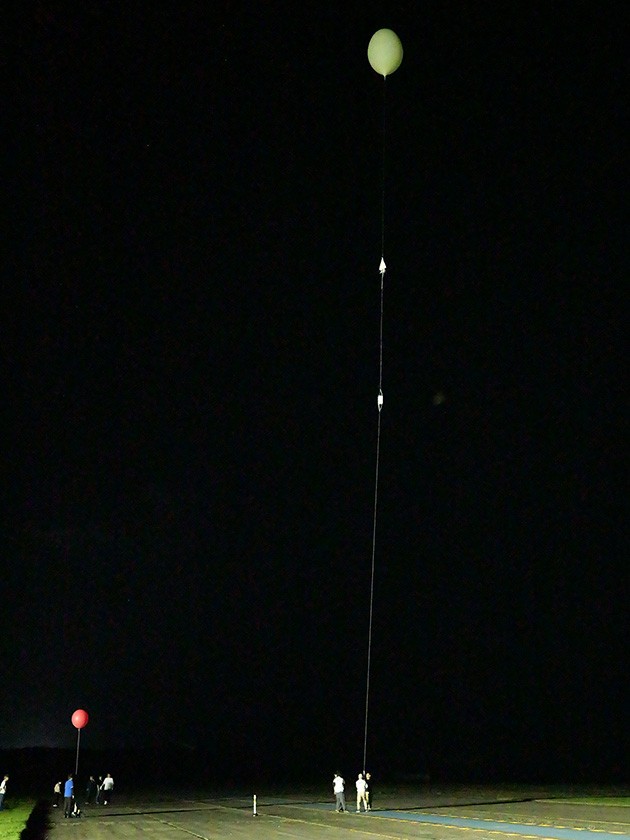
Mission BS26-03 was launched from the Taiki Aerospace Research Field in Hokkaido on 22 August 2026 at 00:00 JST using a rubber balloon measuring 11 meters of diameter. The balloon reached an altitude of approximately 28 km 1 hour 34 minutes after launch, corresponding to an average ascent rate of about 298 m/min over the ascent period. At maximum altitude, the balloon was approximately 25 km east of the Taiki Aerospace Research Field over the Pacific Ocean.
After reaching its maximum altitude, the balloon and its onboard equipment descended gradually toward the ocean. The equipment landed approximately 35 km east of the Taiki Aerospace Research Field.
External references
- Press release about the launch JAXA website
Images of the mission
StratoCat is an independent, non-commercial project maintained to preserve and share the history of scientific and stratospheric ballooning. If you find the site useful, you can help keep it running with a small donation toward its operating costs. Every contribution, even the equivalent of a cup of coffee, is greatly appreciated.