
Purpose of the flight and payload description
The balloon-borne Very Long Baseline Interferometry (VLBI) experiment is a technology demonstration developed by the Japan Aerospace Exploration Agency (JAXA), the National Astronomical Observatory of Japan (NAOJ), and collaborating institutions to evaluate the feasibility of performing Very Long Baseline Interferometry from a stratospheric balloon platform. The objective was to establish interferometric baselines between a balloon-borne radio telescope and ground-based VLBI stations while operating above most atmospheric water vapor, reducing atmospheric absorption and phase fluctuations that limit high-frequency radio observations. The experiment also investigated the use of mobile VLBI elements to improve baseline coverage and imaging performance.
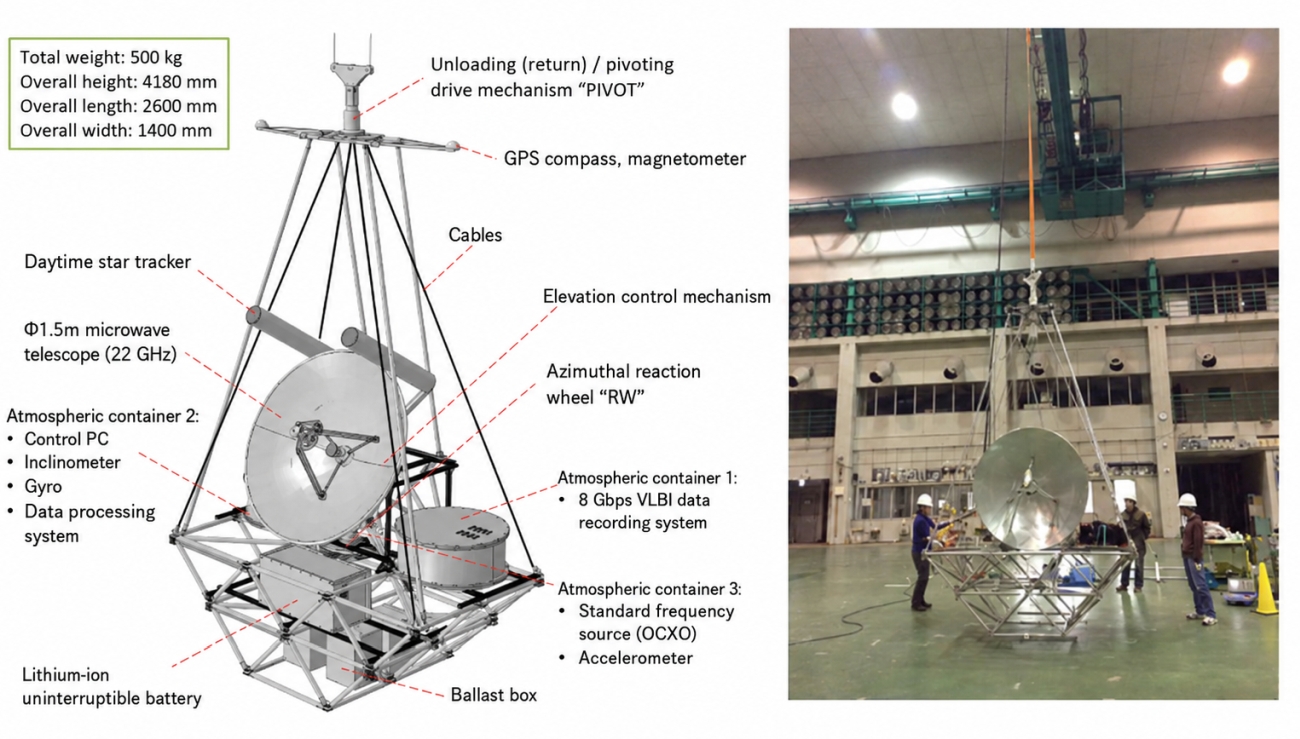
The payload can be seen in the scheme at left (click for more details). It consists of a complete VLBI station weighing approximately 600 kg, including a 1.5 m Cassegrain radio telescope, K-band receivers operating near 20 GHz, an onboard frequency standard, VLBI data recorders, attitude determination and control systems, telemetry equipment, power systems, and environmental control hardware housed in pressurized vessels. The telescope had a beamwidth of approximately 0.6° and a system noise temperature of about 320 K.
The station was designed to operate as one element of a VLBI network with ground-based telescopes in Japan. The primary observation target is the IPSTAR geostationary satellite, whose strong 20 GHz transmission is used to evaluate fringe detection, phase stability, timing synchronization, and interferometric performance. Astronomical radio sources were planned as secondary targets.
The experiment sought to address four key technical requirements: operation of an onboard frequency reference, operation of high-speed VLBI data recorders, accurate telescope pointing on a moving balloon platform, and determination of antenna position with sufficient precision to maintain interferometric coherence. The frequency reference is an oven-controlled crystal oscillator synchronized with GPS timing signals. Two recording systems are installed: a wideband recorder operating at 8.192 Gbps and a secondary recorder operating at 128 Mbps.
Attitude determination uses gyroscopes, GPS compass systems, geomagnetic sensors, sun sensors, accelerometers, and control computers. Telescope pointing is maintained through reaction wheels, azimuth actuators, and elevation drives. Ground tests demonstrated pointing stability of approximately 0.01°. Position variations caused by gondola motion were measured using accelerometers and gyroscopes and later incorporated into correlation processing. Three pressurized vessels maintain near-sea-level environmental conditions for sensitive electronics and recording systems.
Ground and hanging tests successfully detected interferometric fringes between the balloon-borne station and ground telescopes under simulated pendulum motion, demonstrating the functionality of the telescope, clock, recorder, and control systems as a VLBI element. The flight profile called for launch from the Taiki Aerospace Research Field in Hokkaido using a 30,000 m³ balloon. The platform was expected to ascend to approximately 26 km altitude and conduct at least 1.5 hours of VLBI observations during level flight. A first flight was attempted in July 2017 but finaly canceled because of unfavorable surface winds.
Details of the balloon flight
Balloon launched on: 6/14/2026 at 3:50 JST
Launch site: Multipurpose Aviation Research Field, Taiki-Cho, Hokkaido, Japan
Balloon launched by: Institute of Space and Astronautical Science (ISAS) / Japan Aerospace Exploration Agency (JAXA)
Balloon manufacturer/size/composition: Zero Pressure Balloon model B30 30.000 m3
Flight identification number: B26-02
End of flight (L for landing time, W for last contact, otherwise termination time): 6/14/2026 at 7:27 JST
Balloon flight duration (F: time at float only, otherwise total flight time in d:days / h:hours or m:minutes - ): 3 h 30 m
Landing site: 30 km SE of Taiki, Hokkaido, Japan
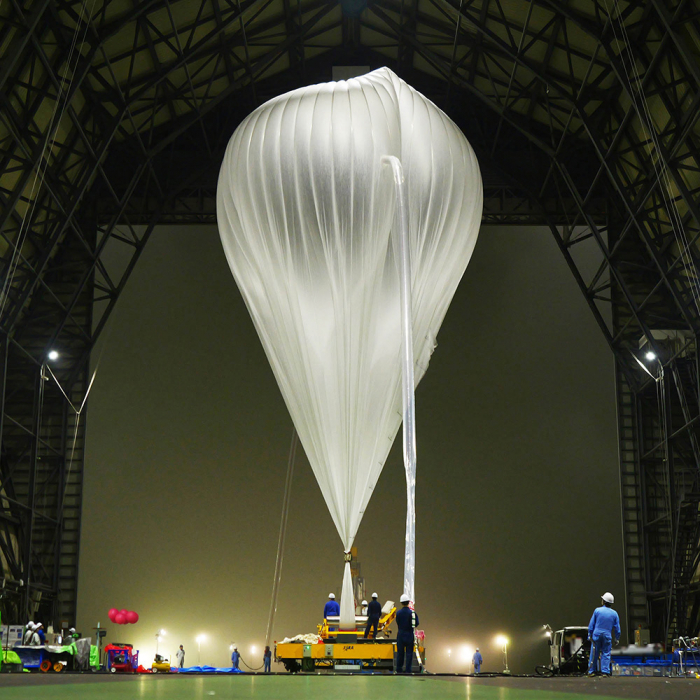
The balloon was launched from the Taiki Aerospace Research Field in Hokkaido, Japan on 14 June 2026, at 3:50 am JST The polyethylene balloon had a fully inflated volume of 30,000 m3 (diameter 42 m) and ascended at a rate of approximately 280 m per minute.
1 hours and 33 minutes after launch, the balloon reached its floating altitude of 26 km over the Pacific Ocean, approximately 50 km ESE from the launch site. At 6:34 am JST, the balloon and the onboard equipment were separated by tele-command and slowly descended onto the sea, landing approximately 30 km SE from the base, where they were recovered by rboats at 7:27 am JST.
External references
- A balloon-borne very long baseline interferometry experiment in the stratosphere: Systems design and developments Advances in Space Research, Volume 63, Issue 1, 2019, Pag. 779
- Press release about the launch JAXA website
Images of the mission
StratoCat is an independent, non-commercial project maintained to preserve and share the history of scientific and stratospheric ballooning. If you find the site useful, you can help keep it running with a small donation toward its operating costs. Every contribution, even the equivalent of a cup of coffee, is greatly appreciated.