
Purpose of the flight and payload description
CORSAIR is the acronym for Coronal Spectropolarimeter for Airborne Infrared Research a balloon-borne infrared coronagraph and spectropolarimeter developed at the Smithsonian Astrophysical Observatory for long-duration observations of the solar corona. It combines an internally occulted coronagraph, a rotating-waveplate polarimeter and a cryogenic spectrometer to obtain two-dimensional spectral imaging of the full polarization state of the corona to one solar radius from the limb. The instrument observes five emission lines at 1.1, 1.4 and 3.9 microns, including density-sensitive Fe XIII, temperature-sensitive Si IX/Si X and He I lines.
CORSAIR measures line-of-sight magnetic-field strength through the longitudinal Zeeman effect and plane-of-sky magnetic azimuth through the saturated Hanle effect. Spectroscopic measurements provide plasma temperature, density, line-of-sight and plane-of-sky velocity, and non-thermal velocity. The spectrometer uses multiple closely spaced slits to acquire the spectral and two spatial dimensions simultaneously, while ultra-narrowband filters minimize background overlap. Operating in multiple spectral orders allows the five emission lines to be measured with similar sensitivity and resolving power. The spectrometer is cooled with liquid nitrogen to approximately -321 °F and enclosed in a vacuum chamber to prevent condensation.
CORSAIR is mounted on the Wallops Arc Second Pointer or WASP, a NASA precision pointing system developed at Wallops Flight Facility for scientific balloon payloads. WASP combines a pointing control system with a star-tracker subsystem and uses a gondola-mounted pitch/yaw articulated gimbal for fine instrument pointing, while the standard NASA gondola rotator provides coarse azimuth positioning. Its pointing system incorporates inner and outer gimbal frames, precision hubs, a fiber-optic gyroscope, avionics, a trim-balance subsystem and a latch mechanism. The system is designed to provide sub-arcsecond pointing, with NASA reporting total pointing error below 1 arcsecond 99.4 percent of the time.
For CORSAIR, WASP provides the line-of-sight pointing required to keep the instrument directed toward the center of the Sun with arcsecond-level stability. The complete assembled CORSAIR payload is reported to weigh approximately 5,000 pounds.
CORSAIRs development program comprises three balloon flights. The first is a one-day qualification flight from Fort Sumner, New Mexico, in 2026, using only the 3.9-micron Si IX line to demonstrate measurement of line-of-sight magnetic-field strength. The second is a one-day commissioning flight from Fort Sumner in 2028, adding the four near-infrared lines, correction for field-of-view rotation, and ultra-narrowband filters enabling 128 closely spaced slits for nearly continuous spatial coverage. The final mission is a one-month Antarctic circumpolar science flight planned for late 2030, providing uninterrupted solar observations for up to one month and the complete set of CORSAIR measurements.
Details of the balloon flight
Balloon launched on: 9/19/2026
Launch site: Scientific Flight Balloon Facility, Fort Sumner, (NM), US
Balloon launched by: Columbia Scientific Balloon Facility (CSBF)
Balloon manufacturer/size/composition: Zero Pressure Balloon
End of flight (L for landing time, W for last contact, otherwise termination time): 9/19/2026 at
Landing site: In the launch base
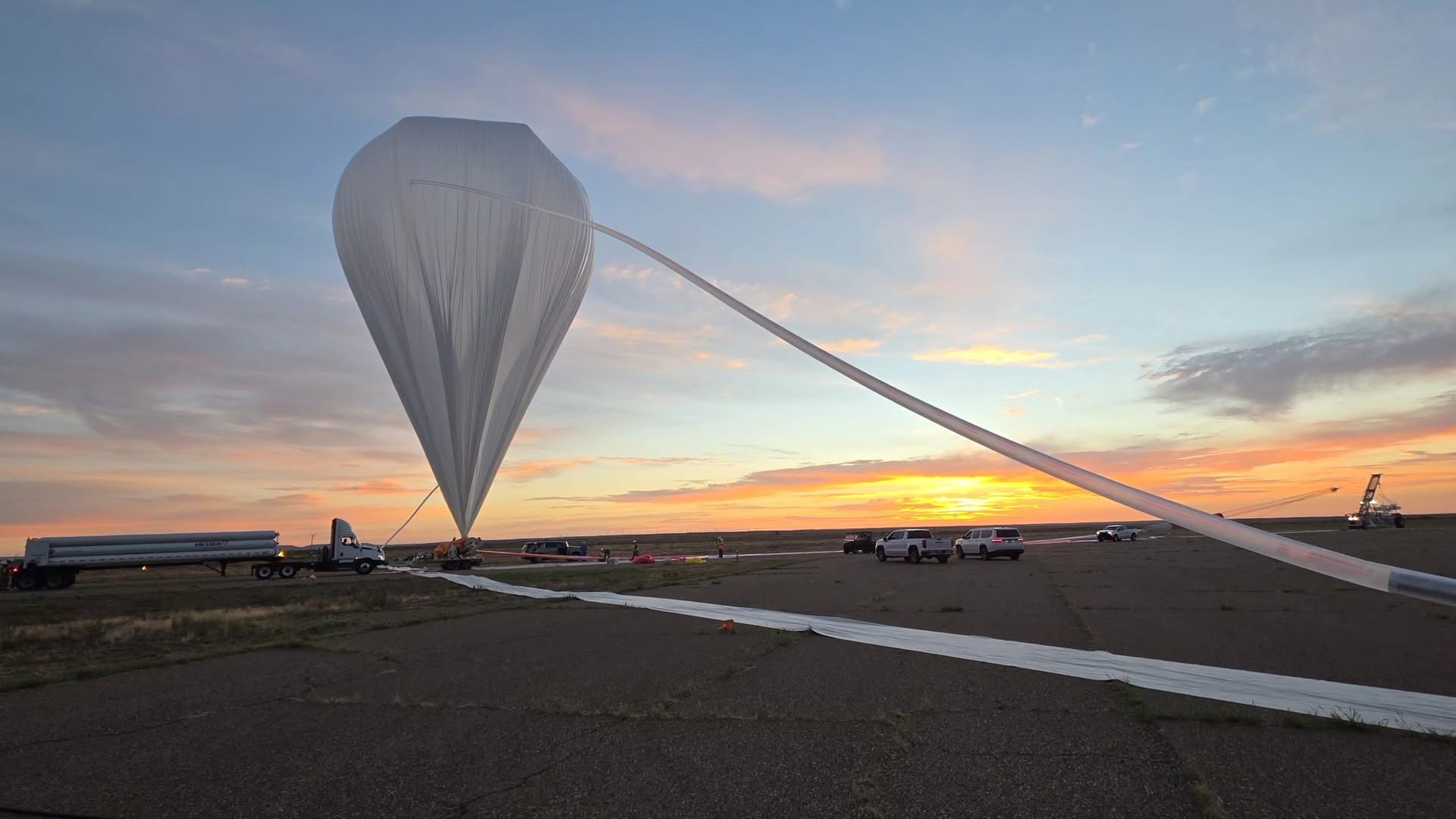
The balloon was attempted to launch on the morning of September 19, 2026 from the NASA balloon base in Fort Sumner, New Mexico. All pre-flight operations went as expected but after balloon release, the scientific instrument impacted the ground. Operators terminated the flight after allowing it to ascend high enough for parachute deployment. There were no injuries or damage to facility property.
External references
Images of the mission
If you consider this website interesting or useful, you can help me to keep it up and running with a small donation to cover the operational costs. Just the equivalent of the price of a cup of coffee helps a lot.