Purpose of the flight and payload description
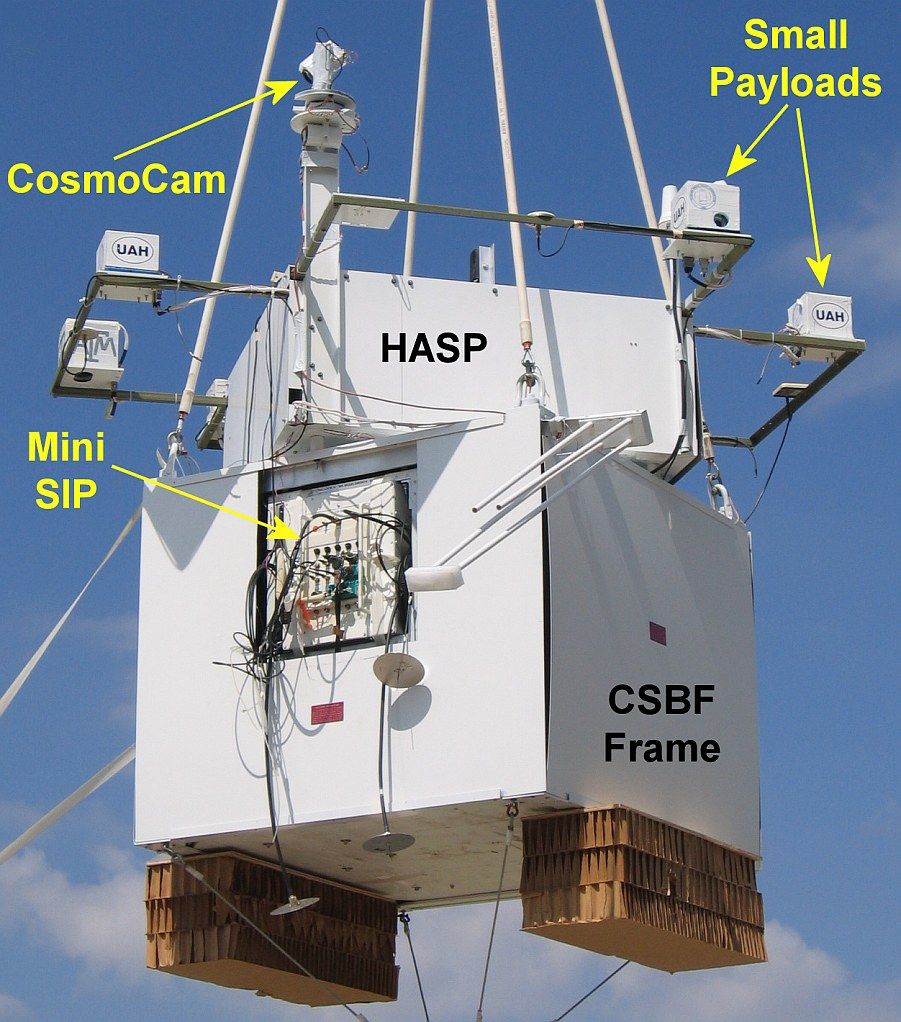
HASP, acronym for High Altitude Student Platform, is an educational program aimed at encouraging student interest in aerospace careers and addressing workforce development needs in the field. The program operates a multi-instrumented platform designed to accommodate student payloads and carry them to an altitude of approximately 36 km, with typical flight durations of 15 to 20 hours. The platform is suspended from a small-volume, zero-pressure balloon. HASP payloads are designed and built by students and are used to flight-test compact satellite systems and prototypes, as well as to conduct small-scale experiments. Construction and operation of the platform have been funded by the State of Louisiana and the Louisiana Space Consortium. Since the program began in 2006, the NASA Balloon Program Office, through the Columbia Scientific Balloon Facility (CSBF), has supported an annual HASP flight.
The complete HASP flight configuration consists of two main components: the CSBF frame at the bottom and the HASP system mounted above it. The CSBF frame provides the primary structural support for the payload and was adapted from an older test payload frame by CSBF. It houses the subsystems required by CSBF to monitor and control the balloon vehicle. On the top corners of this frame are the attachment points for cabling leading to the swivel, flight train, parachute and balloon. Each suspension cable is threaded through a PVC pipe increasing the rigidity of the suspension system and reducing the probability that, upon landing, the swivel would impact student payloads located on the top of HASP. On the bottom of the CSBF frame is the cardboard honeycomb crush pad and attach points for the ballast hopper suspension cables.
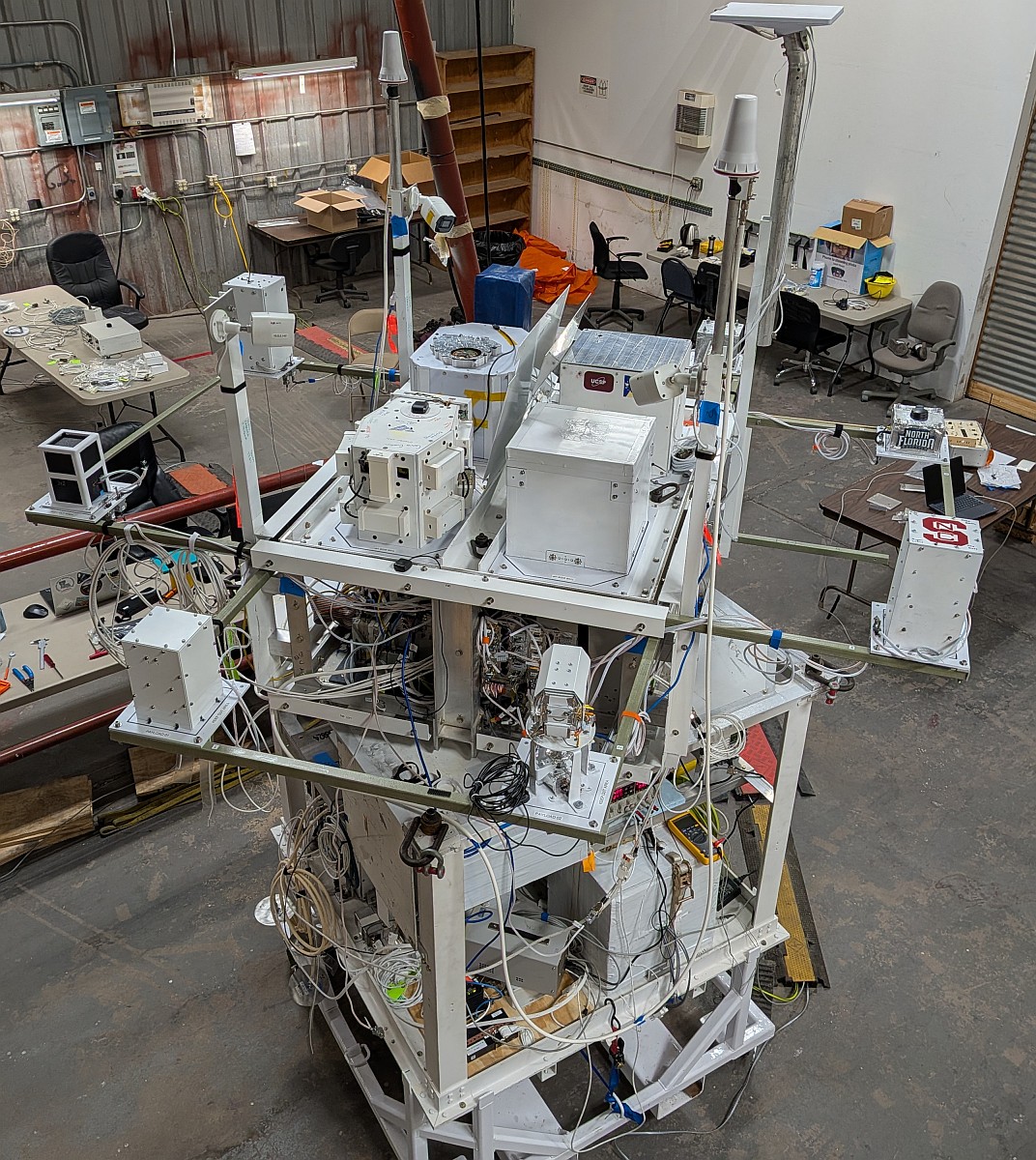
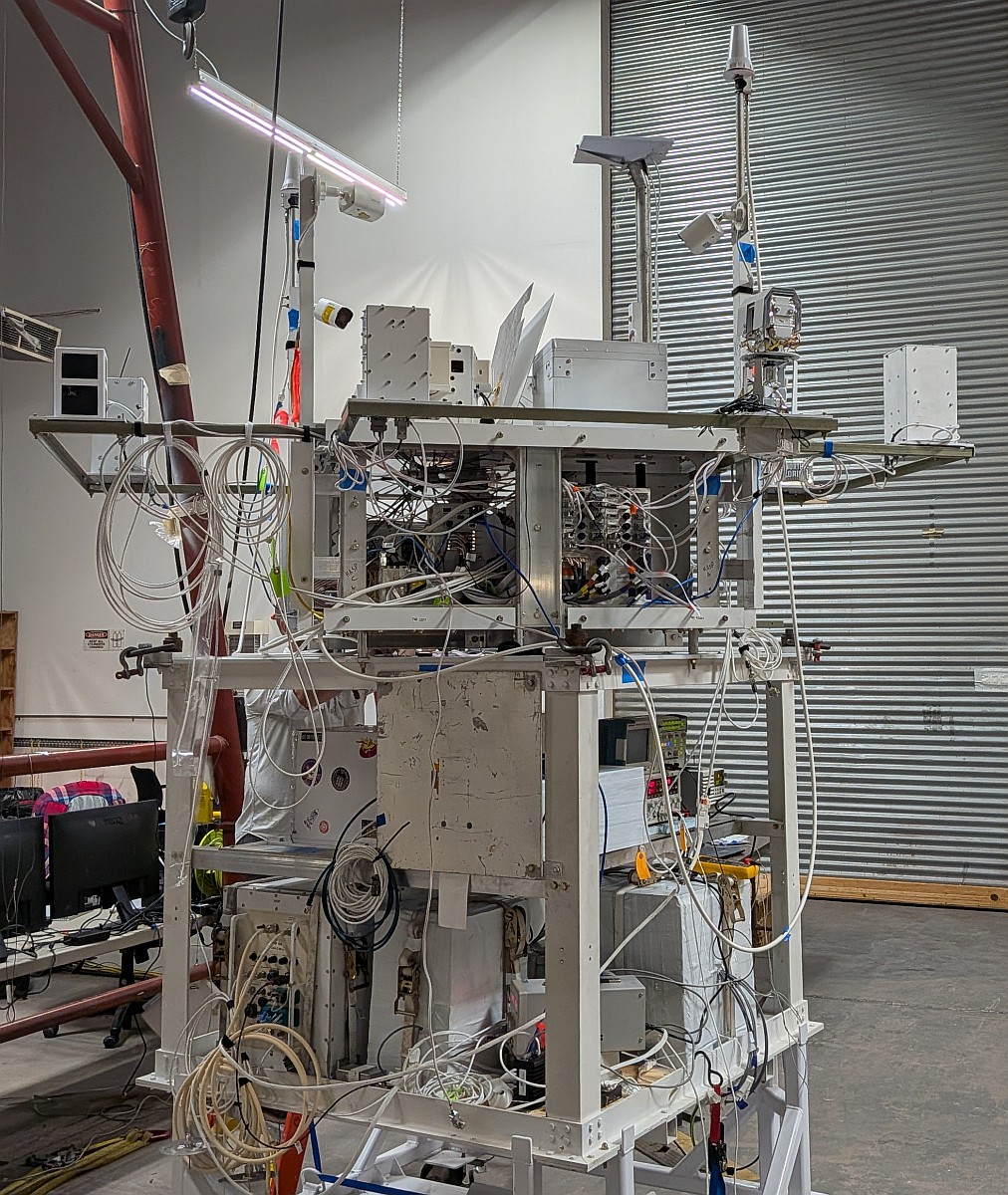
This configuration remained essentially unchanged for 20 years until 2025 when HASP version 2 was introduced as a complete rebuild of the original system. The updated platform retains a footprint similar to the original HASP v1 structure while increasing its payload capacity from 16 to 24 positions, comprising 16 small and 8 large payload seats. The mechanical structure consists of an aluminum central frame attached to the CSBF frame. The v2 configuration incorporates a second fiberglass ring providing eight additional small-payload positions, while a new tray integrated with the CSFB frame accommodates additional large-payload positions and houses flight batteries, communications equipment and related systems. Four attachable camera booms provide configurable mounting points for flight cameras and also serve as mounting locations for the Starlink antenna. The fiberglass booms supporting the small payloads extend approximately 55 cm from the aluminum frame, providing physical separation from the main structure and unobstructed fields of view. Four large payload positions are located on top of the HASP frame, while four additional positions are mounted on the CSBF frame below it.
Small payloads have a maximum mass of 3 kg, a footprint of 15 × 15 cm and a maximum height of 30 cm. Large payloads have a maximum mass of 20 kg, a footprint of 38 × 30 cm and a maximum height of 30 cm. Both classes receive nominally 28 VDC, with an operating range of approximately 2630 VDC. Available current is 0.5 A for small payloads and 2.5 A for large payloads. Each payload is provided with an RS-232 serial interface operating at 9600 baud, one 05 V analog input and up to one active-low open-collector discrete command through an EDAC 516-020 interface.
The electrical system was completely redesigned for HASP v2. The previous three Intel 486 PC/104 flight computers and CompactFlash-based storage were replaced by an RTD i7-based flight computer stack providing 60 GB of storage, 128 analog-to-digital converter channels and 24 additional serial interfaces for payload communications. New power distribution, relay-control, signal-interface and housekeeping systems were developed for the expanded payload capacity. Environmental and system monitoring capacity was increased from 32 to 128 sensors. The primary flight power system consists of approximately 28 V battery packs with a total capacity of 200 Ah.
HASP provides payload command reception, data acquisition and archiving, status telemetry, and in-flight payload control. Payload data are automatically archived onboard and made available through the HASP ground system, allowing recovery of data following a telemetry loss. Commands are transmitted to individual payloads through their serial interfaces, while a separate discrete input can be used for functions such as relay switching or transmitter shutdown.
The communications architecture was expanded from the 33.8 kbps line-of-sight serial downlink used by HASP v1. HASP v2 can use Starlink for telemetry, increasing the available data throughput and permitting higher bandwidth allocation to individual payloads. The standard payload allocation is now 9600 bps per seat, compared with 1200 bps for small and 4800 bps for large payloads on HASP v1. The EVTM system remains available as an additional downlink capability, while the line-of-sight serial link is retained as an independent backup. The platform also provides real-time two-way communication with payloads and at least one video downlink from the flight.
During flight, HASP operates at approximately 120,000 ft, where ambient pressure is typically 510 mbar. The platform provides no thermal control for student payloads, which must therefore accommodate the temperature and low-pressure environment independently.
Details of the balloon flight
Balloon launched on: 9/2/2026 at 14:05 UTC
Launch site: Scientific Flight Balloon Facility, Fort Sumner, (NM), US
Balloon launched by: Columbia Scientific Balloon Facility (CSBF)
Balloon manufacturer/size/composition: Zero Pressure Balloon Raven Aerostar - W11.82-1E-59 - 11.820.000 cuft
Flight identification number: 765N
End of flight (L for landing time, W for last contact, otherwise termination time): 9/2/2026 at 20:45 UTC
Balloon flight duration (F: time at float only, otherwise total flight time in d:days / h:hours or m:minutes - ): 6 h 45 m
Landing site: 10 km SE of Las Vegas, New Mexico, US
External references
Images of the mission


StratoCat is an independent, non-commercial project maintained to preserve and share the history of scientific and stratospheric ballooning. If you find the site useful, you can help keep it running with a small donation toward its operating costs. Every contribution, even the equivalent of a cup of coffee, is greatly appreciated.