
Purpose of the flight and payload description
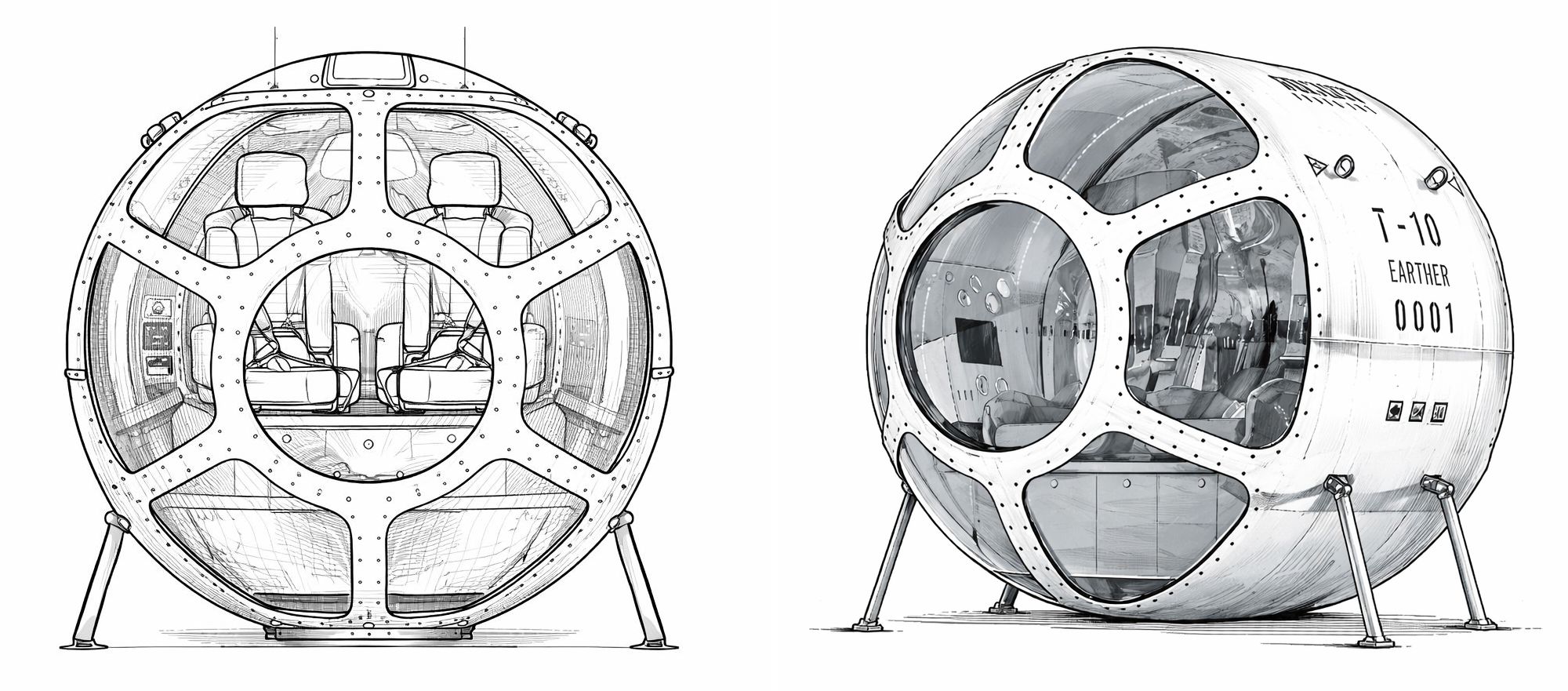
The T-10 EARTHER capsule is a stratospheric passenger balloon-borne vehicle designed for operation at altitudes between 18 and 25 km. It was developed by Iwatani Giken, an Hokkaido-based Japanese firm developing balloon-based tourist flights in Japan. The capsule, which can be seen in the image at left (click for more details), is configured as a spherical pressure vessel with an external diameter of 1.7 meters, its geometry selected to minimize structural stresses under internal pressurization. A large transparent dome approximately 1.5 meters in diameter, manufactured from thick, high-strength polymer, occupies a substantial portion of the forward hemisphere and is capable of withstanding sustained pressure differentials approaching one atmosphere while maintaining optical clarity, impact resistance, and stability under intense ultraviolet radiation.
The rest of the structure consists of a reinforced aluminum shell forming the aft hemisphere, into which are integrated the hatch and the structural attachment points for the suspension system. The capsule provides pressure resistance, airtightness, and thermal insulation within a habitable volume of roughly 2 m³, accommodating two occupants in a fixed seated configuration. The seating consists of two ergonomic chairs equipped with multi-point harnesses, arranged side-by-side with the pilot positioned on the left, where the control panel and flight instruments are also located within reach. The internal layout prioritizes forward and lateral visibility through the dome, enabling near-panoramic observation of the Earths curvature and the upper atmosphere. Avionics, electronic systems, and batteries are installed below the seats. The capsule is connected to the balloon via a ring, which in turn attaches to the balloons equator at several points using high-strength nylon rope in a catenary-like arrangement. This ring also functions to limit excessive capsule rotation during both ascent and descent. Unlike most balloon-borne manned vehicles, there is no parachute between the balloon and the capsule; instead, the balloon envelope is designed to assume a parachute-like configuration in the event of envelope failure, maintaining a controlled descent rate.
The balloon is equipped with three types of valves and a ballast drop mechanism to control buoyancy, thereby enabling adjustment of altitude and vertical speed. In addition to gas release through an in-flight manual valve and two electrically actuated valves (which can also be remotely controlled from the ground) buoyancy can be further regulated through the controlled release of ballast installed both inside and outside the capsule, allowing increases or decreases in vertical velocity as required.
The environmental control system is designed to maintain a near sea-level internal atmosphere without the need for pressure suits. This includes active regulation of oxygen partial pressure, the incorporation of a carbon dioxide removal system, thermal management that mitigate both conductive and radiative heat losses, and humidity control systems for the removal of internal condensation affecting visibility.
Onboard systems include telemetry links for the transmission of altitude, position, and cabin environmental data to ground stations, which can in turn initiate or assist in flight profile adjustments remotely, including controlled descent procedures in contingency scenarios. In the event of a sudden decompression, onboard oxygen masks and personal parachutes are provided to protect both pilot and passenger.
Video resume of the mission
Details of the balloon flight
Balloon launched on: 3/10/2024
Launch site: Makubetsu, Hokkaido, Japan
Balloon launched by: Iwatani Giken
Balloon manufacturer/size/composition: Zero Pressure Balloon
End of flight (L for landing time, W for last contact, otherwise termination time): 3/10/2024
External references
StratoCat is an independent, non-commercial project maintained to preserve and share the history of scientific and stratospheric ballooning. If you find the site useful, you can help keep it running with a small donation toward its operating costs. Every contribution, even the equivalent of a cup of coffee, is greatly appreciated.