
Purpose of the flight and payload description
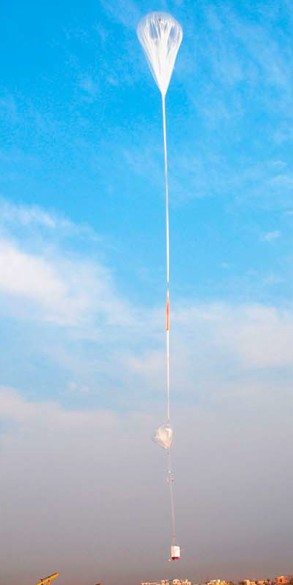
The objective of the flight was to obtain in situ vertical profiles of black carbon (BC) mass concentration in the troposphere over Hyderabad, India, particularly to investigate the presence and distribution of elevated aerosol layers that had not previously been characterized over the region. The measurements formed part of the Regional Aerosol Warming EXperiment (RAWEX), with flights conducted in different seasons to examine the vertical distribution of BC under varying atmospheric conditions. The program was carried out by the Space Physics Laboratory of the Vikram Sarabhai Space Centre, the National Balloon Facility of the Tata Institute of Fundamental Research (TIFR) in Hyderabad, the Centre for Atmospheric and Oceanic Sciences of the Indian Institute of Science, and the Divecha Centre for Climate Change at the Indian Institute of Science.
The instrument used for the measurements was a Magee Scientific Model AE42 Portable Aethalometer, a filter-based optical aerosol absorption analyzer designed for continuous measurement of equivalent black carbon (EBC). It was configured for 880 nm wavelength operation because absorption by other aerosol components is relatively small at that wavelength. The portable AE42 used the same aerosol collection, optical analysis, electronics, and data-processing principles as Magee's larger rack-mounted Aethalometers, but was housed in a compact chassis with battery capability.
The measurement system continuously draws aerosol-laden air through a sample inlet and deposits the particles on a section of quartz-fiber filter tape. A light source and detector measure the transmission of the filter at the measurement wavelength. As absorbing aerosol accumulates on the filter, transmitted light decreases. The instrument calculates optical attenuation from the change in transmission between the loaded portion of the filter and an unexposed reference area. The measured attenuation is converted into an aerosol absorption and then into equivalent black-carbon mass concentration using an effective mass absorption cross section.
The aethalometer was housed in a portable chassis measuring approximately 279 × 203 × 305 mm and weighing about 11.3 kg. It included a four-line display, status LEDs and detachable keypad, with digital data available through an RS-232 interface and an analog 05 V output. Data could be recorded on removable Compact Flash storage, while the instrument could operate from its internal 12 V rechargeable battery or an external 12 V supply. The instrument operated with a 5-second measurement interval. Its data were transmitted to the ground and stored onboard, while the associated GPS system supplied latitude, longitude, altitude and time. Because the available airflow became insufficient above roughly 9 km, the instrument was remotely switched off at higher altitudes and restarted during descent.
Details of the balloon flight
Balloon launched on: 4/27/2011
Launch site: TIFR National Balloon Facility, Hyderabad, India
Balloon launched by: National Balloon Facility, Tata Institute of Fundamental Research
Balloon manufacturer/size/composition: Zero Pressure Balloon 38.200 m3
End of flight (L for landing time, W for last contact, otherwise termination time): 4/27/2011
Balloon flight duration (F: time at float only, otherwise total flight time in d:days / h:hours or m:minutes - ): F 1 h 20 m
Payload weight: 168 kgs
External references
- Balloon launch records Tata Institute of Fundamental Research
- Increasing Airplane emissions threatening the climate? Indian Institute of Science website, Bengaluru
StratoCat is an independent, non-commercial project maintained to preserve and share the history of scientific and stratospheric ballooning. If you find the site useful, you can help keep it running with a small donation toward its operating costs. Every contribution, even the equivalent of a cup of coffee, is greatly appreciated.