
Purpose of the flight and payload description

BESS POLAR II stands for Balloon-borne Experiment with a Superconducting Spectrometer - POLAR VERSION. Its main objective was the precise measurement of cosmic-ray antiparticles, particularly low-energy antiprotons, in order to identify possible contributions from exotic sources such as dark matter annihilation or the evaporation of primordial black holes. The experiment sought to extend the antiproton energy spectrum down to 0.2 GeV, a region where the background from secondary cosmic-ray interactions with interstellar matter was minimal. Through its long-duration balloon flight during the solar minimum in 2007, Polar-BESS II aimed to detect subtle deviations in the antiproton flux that might indicate non-standard astrophysical or cosmological processes. The instrument was developed through an extensive collaboration that included the NASA Goddard Space Flight Center (GSFC), the University of Maryland, Kobe University, Institute of Space and Astronautical Science (ISAS) and the National Laboratory for High Energy Physics (KEK) among other institutions from Japan and the United States.
In the image at left we can see a cross-section and side views of the instrument (click for more details). Polar BESS II was a high-resolution magnetic-rigidity spectrometer that used a thin superconducting solenoid magnet, 0.9 meters in diameter and 1.4 meters in length, producing a highly uniform magnetic field of 0.8 Tesla during operation, although it was capable of 1 Tesla in persistent mode. The magnet was made of NbTi/Cu wire reinforced with a high-strength aluminum stabilizer containing Ni-doped filaments to increase durability. It operated with a 520-liter liquid helium reservoir that ensured 25 days of cryogenic stability during the flight. The total material thickness per wall of the magnet and cryostat was about 2.46 g/cm², minimizing multiple scattering and allowing better low-energy resolution.
Inside the magnet's warm bore sat the tracking system, composed of a central jet-cell drift chamber (JET) surrounded by two inner drift chambers (IDC). Together they provided 52 measurement points for each charged-particle trajectory, with a spatial resolution of 125 micrometers in the bending direction. Vernier pads on each IDC layer gave a 650-micrometer resolution perpendicular to the bending plane, while charge-division measurements in the JET chamber yielded a 24-millimeter resolution along the wire. The magnetic rigidity, was derived from the curvature of the particle track, allowing the determination of momentum and charge sign. The instrument achieved a maximum detectable rigidity (MDR) of 240 GV.
Time-of-flight (TOF) scintillator arrays were located at the top and bottom of the instrument, denoted as UTOF and LTOF respectively, with an additional middle TOF (MTOF) installed inside the magnet bore below the lower IDC. These scintillators provided the trigger system and measured both the charge and velocity of incident particles.
An Aerogel Cherenkov counter (ACC) was mounted below the cryostat to suppress background from light, high-energy muons and electrons. This feature extended the antiproton measurement capability up to 3.6 GeV. The overall design minimized material in the particle path to reduce multiple scattering, which was crucial for low-energy measurements.
Details of the balloon flight
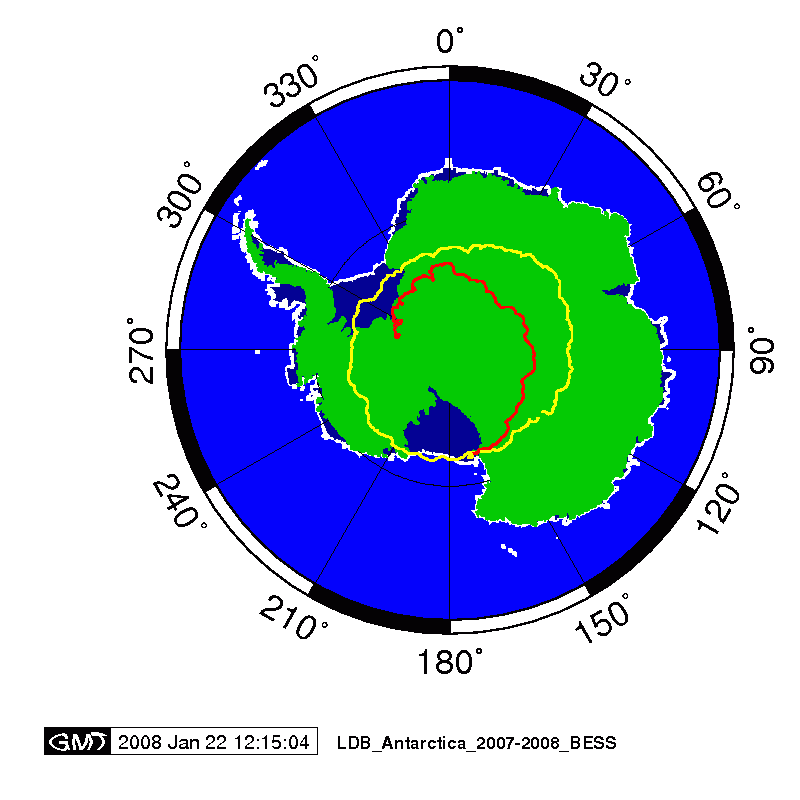
Balloon launched on: 12/23/2007
Launch site: Williams Field, McMurdo Station, Antarctica
Balloon launched by: Columbia Scientific Balloon Facility (CSBF)
Balloon manufacturer/size/composition: Zero Pressure Balloon Raven - 39.000.000 cuft - (0.8 Mil)
Flight identification number: 578N
End of flight (L for landing time, W for last contact, otherwise termination time): 1/22/2008 at 8:18
Balloon flight duration (F: time at float only, otherwise total flight time in d:days / h:hours or m:minutes - ): 30 d 15 h 37 m
Landing site: 225 nautic miles SE of the Patriot Hills Station.
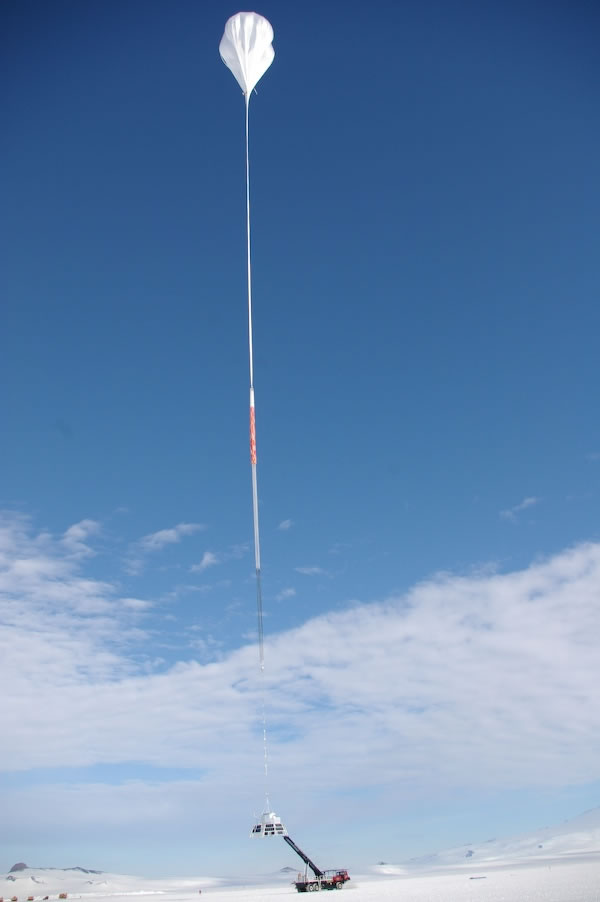
The BESS-Polar II mission was launched from Williams Field near McMurdo Station, Antarctica, on December 23, 2007, and it circled the South Pole for 30 days, of which 24.5 days were with the magnet energized. The payload landed on January 22, 2008 225 nautic miles SE of the Patriot Hills Station in Antarctica. the data vaults were recovered during a first expedition to the landing site on February 3, 2008. The instrument itself was left on the ice and recovered during the 2008/2009 summer season by setting staging camp on WAIS Divide/Byrd Surface Camp. Due to the remote location of the landing the team camped on the site for 13 days for disassembly. It was necessary the use of the Basler turboprop DC-3 due to range and instrument size.
During the flight Polar BESS recorded 4.7 × 10? events, equivalent to 13.6 terabytes of unfiltered data.
External references
- BESS web site HIGH ENERGY ACCELERATOR RESEARCH ORGANIZATION
- Balloons Away Antarctic Sun
- BESS-Polar balloon-borne superconducting spectrometer successfully launched for Antarctic flight KEK press release
- Measurement of the Cosmic-Ray Antiproton Spectrum at Solar Minimum with a Long-Duration Balloon Flight over Antarctica PRL 108, 051102 (2012)
- Measurements of Cosmic-Ray Proton and Helium Spectra from the BESS-Polar Long-duration Balloon Flights over Antarctica Astrophysical Journal, Volume 822, Issue 2, p 65
- New result of Antideuteron search in BESS-Polar II
- Old BESS website University of Maryland
- Scientific Balloons Achieve Antarctic Flight Record National Science Foundation press release
- The 2007 BESS-Polar Scientific Flight in Antarctica Transactions Of The Japan Society For Aeronautical And Space Sciences, Space Technology Japan, 2009 Volume 7 Issue ists26 Pages Tm_37-Tm_45
- The BESS-Polar II lower-energy antiproton flux using the upper-middle TOF trigger mode 39th International Cosmic Ray Conference (ICRC2025)
- The results from BESS-Polar experiment To appear in: Advances in Space Research
- The second Antarctic Flight of BESS-Polar Experiment: Flight Summary and Detector Performance PROCEEDINGS OF THE 31st ICRC, LODZ 2009
- The upper limit on antideuteron flux with BESS-Polar II 38th International Cosmic Ray Conference (ICRC2023)
Images of the mission
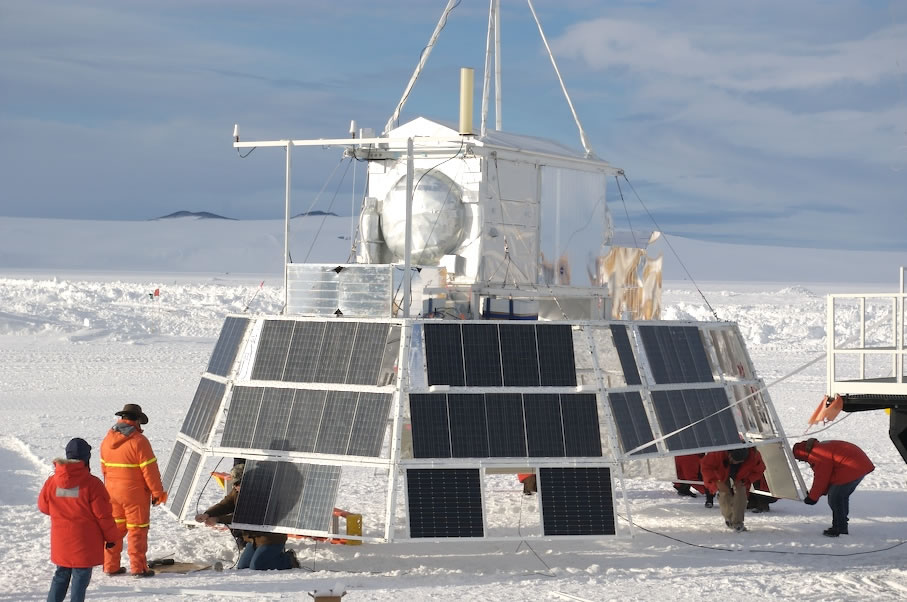
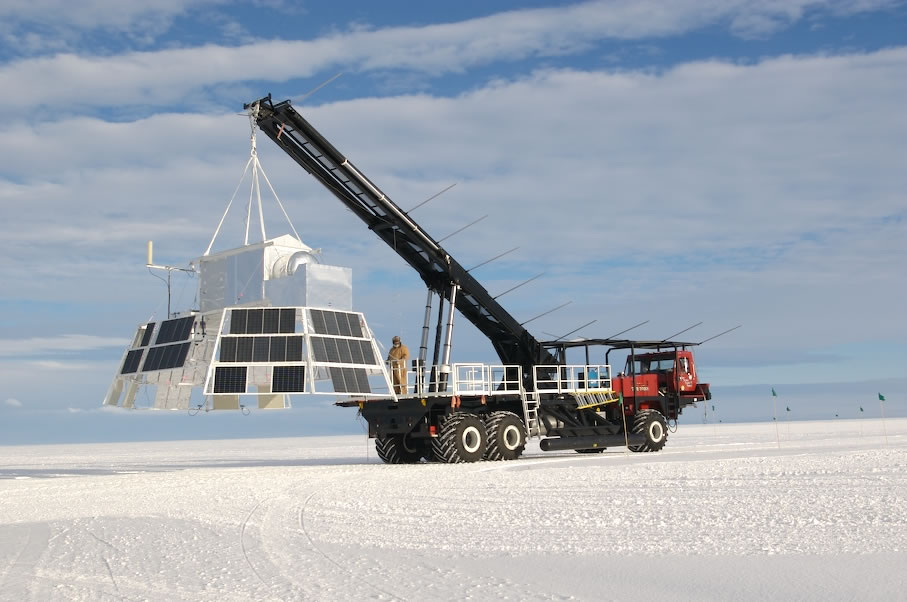
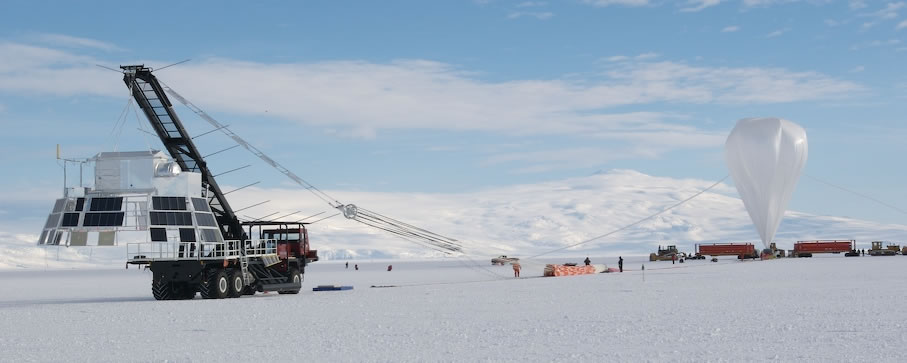

StratoCat is an independent, non-commercial project maintained to preserve and share the history of scientific and stratospheric ballooning. If you find the site useful, you can help keep it running with a small donation toward its operating costs. Every contribution, even the equivalent of a cup of coffee, is greatly appreciated.