
Purpose of the flight and payload description
The TRIP (Telescope Raffreddato per lInfrarosso su Pallone) was a balloon-borne cryogenically cooled infrared telescope designed for measuring the Near Infrared Cosmological Background (NIRB) in the 15 µm range at an altitude of approximately 40 km. It was developed by two Italian research institutions affiliated with the National Research Council (CNR): the Istituto per le Tecnologie e Studio delle Radiazioni Extraterrestri, in Bologna and the Istituto di Ricerca sulle Onde Elettromagnetiche, in Florence.
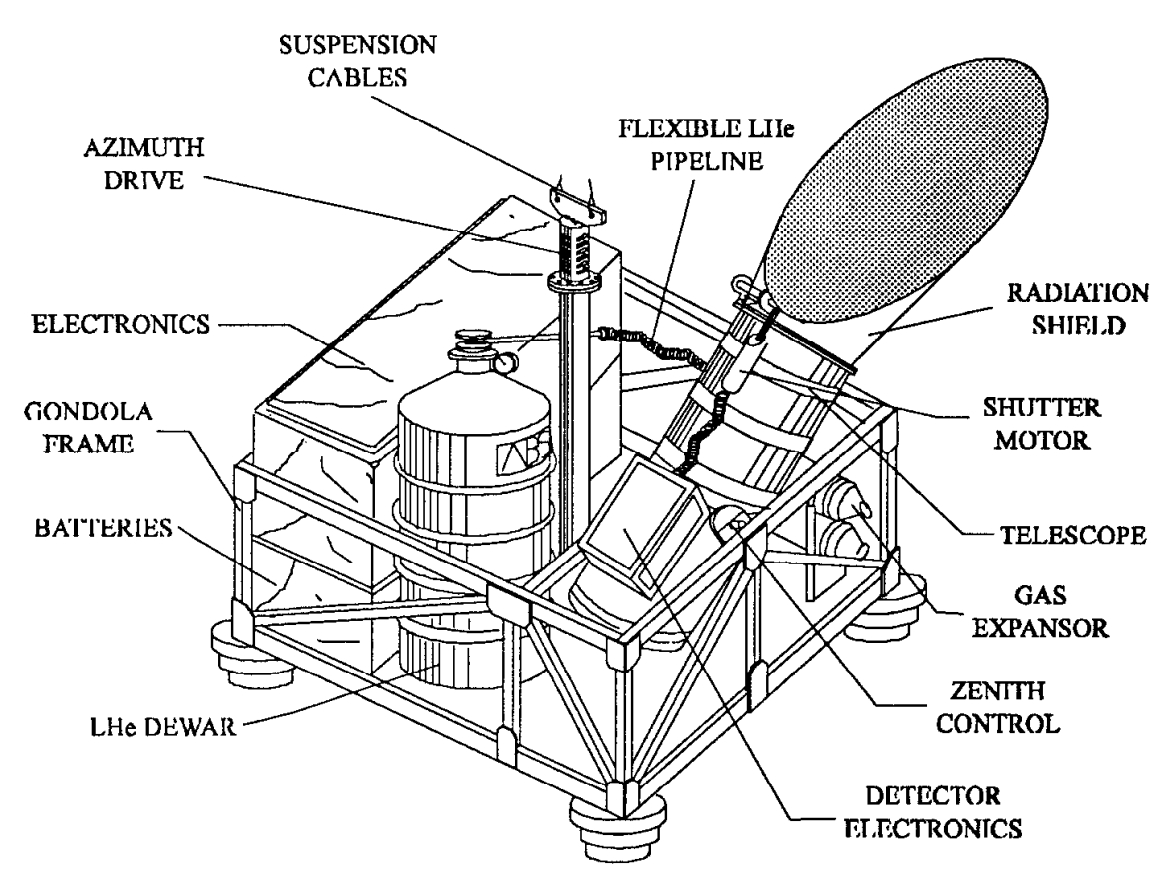
In the image at left we can see an scheme of the instrument (click to enlarge). The telescope had a 250 mm primary mirror with an F/2 focal ratio and was designed to minimize thermal noise through cryogenic cooling. The optical system was a double Cassegrain configuration, and the focal plane included a 32-element linear array of InSb detectors, cooled and stabilized at around 52 K, which allowed a field of view of 1.4 arcmin per pixel over a total view of 49 arcmin.
The cryogenic system operated using liquid helium delivered through a transfer line from an external dewar. The helium gas flow was controlled using electrovalves and pressure transducers to stabilize the detector temperature with high precision. Most internal surfaces, including baffles and optics supports, were cooled to temperatures below 120 K to reduce their thermal emission. The telescope structure itself was enclosed in a multi-layer vacuum-insulated cryostat, which also housed a rotating shutter to prevent ice formation during ascent and on-ground tests.
A filter wheel positioned in front of the detector carried seven passband filters and one dark filter, enabling differential measurements to separate various background contributions (zodiacal emission, starlight, and atmospheric emission). Observing strategies included zenith, galactic, and ecliptic scans to isolate different components of the background. The system relied on in-flight calibrations using internal lamps and natural celestial sources, with calibration sequences designed to track and raster-scan calibration stars.
The payload, weighing about 850 kg, was suspended within a gondola and stabilized in azimuth using a magnetometer-controlled system. The elevation was independently controlled, and angular resolution was monitored using a CCD aspect camera. Electronics onboard included two CPUs: one for general experiment control and telemetry, and the other for detector control and data acquisition. A 16-bit ADC converted detector output, and telemetry data were transmitted to ground in real time, where they were analyzed using UNIX and Windows-based software.
Aditionally, a second experiment was included onboard to measure atmospheric emission in the 87101 GHz band, centered near 94 GHz, a range relevant to cosmic microwave background (CMB) observations and influenced by strong ozone (O3) spectral lines. The instrument was a Dicke-switched radiometer using monolithic microwave integrated circuits (MMIC) and high electron mobility transistor (HEMT) amplifiers and was developed at Lucent Technologies and the University of Massachusetts.
Details of the balloon flight
Balloon launched on: 6/13/1995 at 1:22 utc
Launch site: National Scientific Balloon Facility (NSBF), Palestine, Texas, US
Balloon launched by: National Scientific Balloon Facility (NSBF)
Balloon manufacturer/size/composition: Zero Pressure Balloon SF3-392.73-080-NSCR-02
Balloon serial number: W23.50-3-06
Flight identification number: 1542P
End of flight (L for landing time, W for last contact, otherwise termination time): 6/13/1995 at 11:50 utc
Balloon flight duration (F: time at float only, otherwise total flight time in d:days / h:hours or m:minutes - ): F 7 h 42 m
Landing site: 12 miles SW of Brady, Texas, US
External references
- Balloon-borne measurements of the atmospheric emission near 94 GHz Journal of Atmospheric and Solar-Terrestrial Physics, Volume 60, Issue 1, p. 71-80
- Observations of the diffuse near-IR sky emission with a balloon-borne infrared telescope (TRIP) Astronomy and Astrophysics, v.331, p.463-470 (1998)
- TRIP: a cold telescope for measurements of the Near Infrared Cosmological Background at balloon altitudes Experimental Astronomy 1995, Volume 6, Issue 1-2, pp 59-82
Images of the mission
StratoCat is an independent, non-commercial project maintained to preserve and share the history of scientific and stratospheric ballooning. If you find the site useful, you can help keep it running with a small donation toward its operating costs. Every contribution, even the equivalent of a cup of coffee, is greatly appreciated.