
Purpose of the flight and payload description
The objective of the flight was to investigate high-energy astrophysical phenomena by capturing and analyzing gamma rays originating from the Galactic disc, particularly focusing on the central region of the Galaxy using a GAMMA RAY TELESCOPE developed by the Physics Department of Imperial College London. The data collected by the instrument contributed to determining the gamma-ray energy spectrum in this region, improving the understanding of cosmic-ray interactions and high-energy processes occurring within the Milky Way.
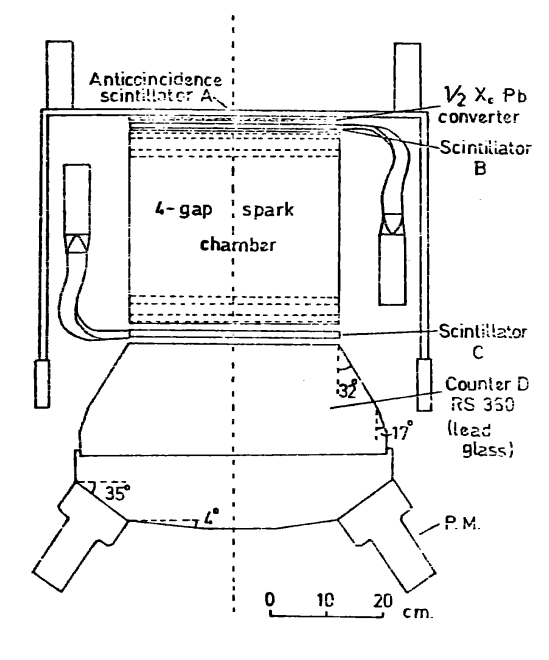
In the image at left can be seen a schematic diagram of the telescope (click to enlarge). It consisted of a detection system based on a spark chamber and lead converter design. Incoming gamma rays were converted into electron-positron pairs upon interaction with the lead material. These charged particles then passed through the spark chamber, which recorded their trajectories, enabling the determination of the original gamma-ray direction. The angular resolution of the instrument was characterized by the half-angle of the cone that contained 68% of the detected events. This angular resolution varied with energy and was calculated theoretically based on the known spatial resolution of the spark chamber and Monte Carlo simulations of scattering processes within the converter material. Additionally, the design of the instrument incorporated an anticoincidence shield intended to reject spurious signals, particularly those caused by large-angle scattering electrons. However, tests of the detectors efficiency showed minimal occurrence of such spurious signals in practice, indicating the effectiveness of the shield and the overall system configuration.
The structural layout of the telescope included multiple spark gaps aligned vertically, with lead plates functioning as converters between these gaps. Each gamma-ray event triggered a coincident signal that initiated data capture in the spark chamber, resulting in a three-dimensional reconstruction of the electron-positron tracks. This setup enabled precise reconstruction of the gamma-ray direction and energy, essential for mapping gamma-ray sources and measuring the energy spectrum. The system was housed in a protective casing suitable for high-altitude flight and integrated with the balloon's power and telemetry systems.
Details of the balloon flight
Balloon launched on: 11/7/1975 at 6:14 cst
Launch site: Australian Balloon Launching Station, Alice Springs, Australia
Balloon launched by: ABLS Mildura
Balloon manufacturer/size/composition: Zero Pressure Balloon 10.600.000 ft3
Flight identification number: HIBAL-639
End of flight (L for landing time, W for last contact, otherwise termination time): 11/7/1975 at 17:20 cst
Balloon flight duration (F: time at float only, otherwise total flight time in d:days / h:hours or m:minutes - ): 11 h 58 m
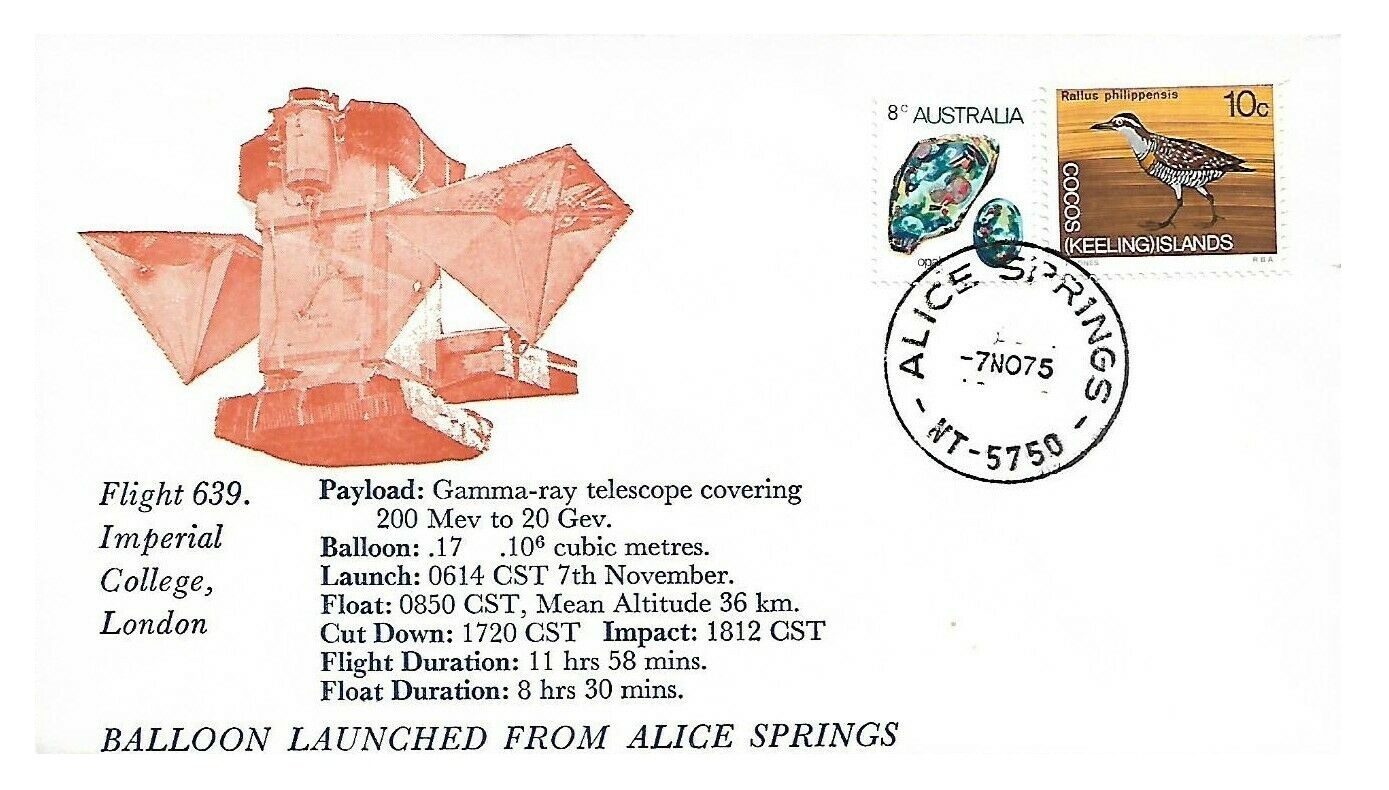
Postal cover issued on launch day commemorating the flight
External references
- Gamma ray observations in the energy range 0.3 J. Phys. E: Sci. Instrum. 15, 462 (1982)
- Gamma Ray Spectrum from the Galactic Disk 15th International Cosmic Ray Conference, Vol. 1 pag. 8
- Information obtained from a postal cover issued in occasion of the flight
StratoCat is an independent, non-commercial project maintained to preserve and share the history of scientific and stratospheric ballooning. If you find the site useful, you can help keep it running with a small donation toward its operating costs. Every contribution, even the equivalent of a cup of coffee, is greatly appreciated.