
Purpose of the flight and payload description
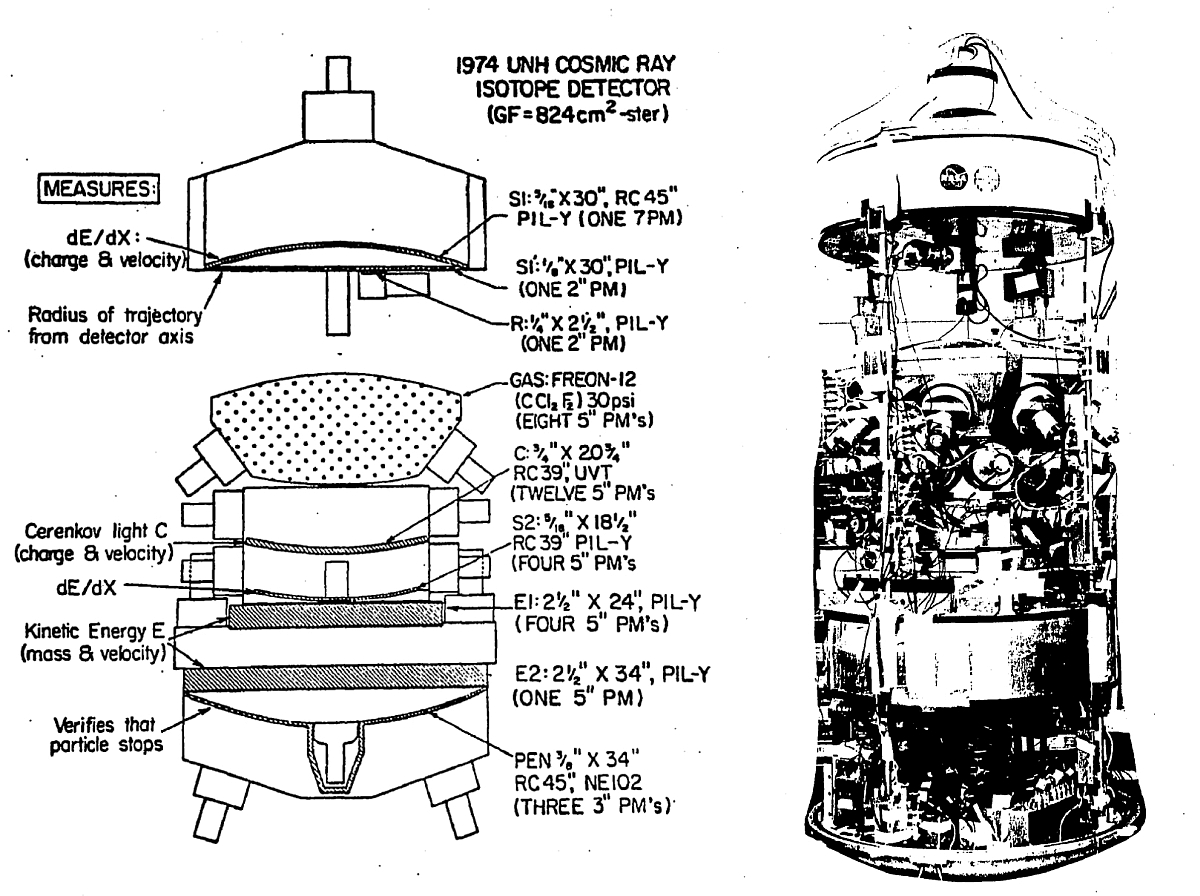
Objective of the flight was to study the isotopic composition, energy spectra, and elemental abundances of cosmic rays ranging from helium (Z=2) to nickel (Z=28) using a MULTILEMENT TELESCOPE developed at the Departament of Physics of the University of New Hampshire.
The primary goal was to obtain high-precision measurements of isotopic abundances, essential for understanding the origin and propagation of cosmic rays in the galaxy. To achieve this, the system was designed to provide a mass resolution of less than one atomic mass unit (AMU) for nuclei in this charge range. The measurements were conducted in what is called the "stopping mode," where incoming particles are slowed and brought to rest within the thick scintillator counters E1 and E2, which allows the most detailed information about isotopic composition to be extracted.
The apparatus (which can be seen schematically in the image at left) consisted of a multilayered telescope with various detection components arranged vertically. At the top were the thin scintillator detectors S1 and S2, which measured the rate of energy loss (dE/dx) and defined the geometry of the telescope. These were followed by the Cerenkov detector (C), which determined particle velocity and contributed to isotopic separation by exploiting the fact that heavier isotopes of the same charge and speed penetrate deeper into the subsequent energy counters.
Below the Cerenkov detector were the thick scintillators E1 and E2, responsible for measuring the residual kinetic energy of particles and determining whether the particle had stopped. The penetration detector (PEN) at the bottom helped identify whether the particle exited the instrument or not. An auxiliary detector, S1*, was used in conjunction with S1 to calculate the radial distance of the particles trajectory from the detector axis, which allowed for pathlength corrections to improve measurement precision.
The detectors were designed to operate in the harsh environment of the upper atmosphere, with careful control over detector thickness, photomultiplier gain matching, and light collection uniformity through compensation techniques such as airbrushed reflective coatings and careful calibration using muons and radioactive sources.
The Cerenkov detector was especially sensitive to particle velocity and required high light collection efficiency due to its relatively low light yield, which was addressed through the use of twelve photomultiplier tubes and reflective internal surfaces.
The entire detector was wrapped in 4 inches of polyurethane foam insulation, and carried two heavy duty batteries driving resistive heaters, to moderate the temperature extremes.
Unlike other contemporary balloon experiments that employed complex position-sensitive arrays to fully reconstruct particle trajectories, this experiment opted for a simpler, more reliable approach. By using only one radial coordinate and suitably curved detectors, it achieved a large geometrical factor without compromising resolution. This strategy enabled the instrument to gather statistically significant data on rare heavy nuclei with minimal event rejection, thereby enhancing the overall effectiveness and efficiency of isotopic measurements in cosmic ray research.
Details of the balloon flight
Balloon launched on: 7/21/1974
Launch site: Fort Churchill Airport, Manitoba, Canada
Balloon launched by: Raven Industries Inc.
Balloon manufacturer/size/composition: Zero Pressure Balloon
End of flight (L for landing time, W for last contact, otherwise termination time): ??/??/1974
Campaign: SKYHOOK CHURCHILL 74
External references
- Cosmic Ray Isotopic composition: Neon through Iron SIMPSON, George Arthur, Doctoral Dissertation 1977
- The charge composition and energy spectra of cosmic-ray nuclei from 3000 MeV per nucleon to 50 GeV per nucleon Astrophysical Journal, Part 1, vol. 223, July 15, 1978, p. 676-696
StratoCat is an independent, non-commercial project maintained to preserve and share the history of scientific and stratospheric ballooning. If you find the site useful, you can help keep it running with a small donation toward its operating costs. Every contribution, even the equivalent of a cup of coffee, is greatly appreciated.