Purpose of the flight and payload description
The objective of the flight was to measure ozone concentration and profile, determine nitric oxide levels, study ozone depletion caused by released nitric oxide, and analyze pollutant dispersion rates in the upper atmosphere. This experiment, carried out by the Naval Research Laboratory (NRL) along with the Department of Transportation (DOT) served as a reference to interpret and calibrate the data obtained from the S082B Coronal XUV Spectrograph aboard Skylab, which had recorded solar images through the Earth's atmosphere during the third manned mission of the spacecraft. Since ozone absorbs short-wavelength ultraviolet radiation, its varying concentration affected the Skylab measurements, making the balloon data essential for accurate correction. Additionally, the results from the flight contributed to the DOT's research on the potential climatic impact of nitric oxide emissions from supersonic transport aircraft.
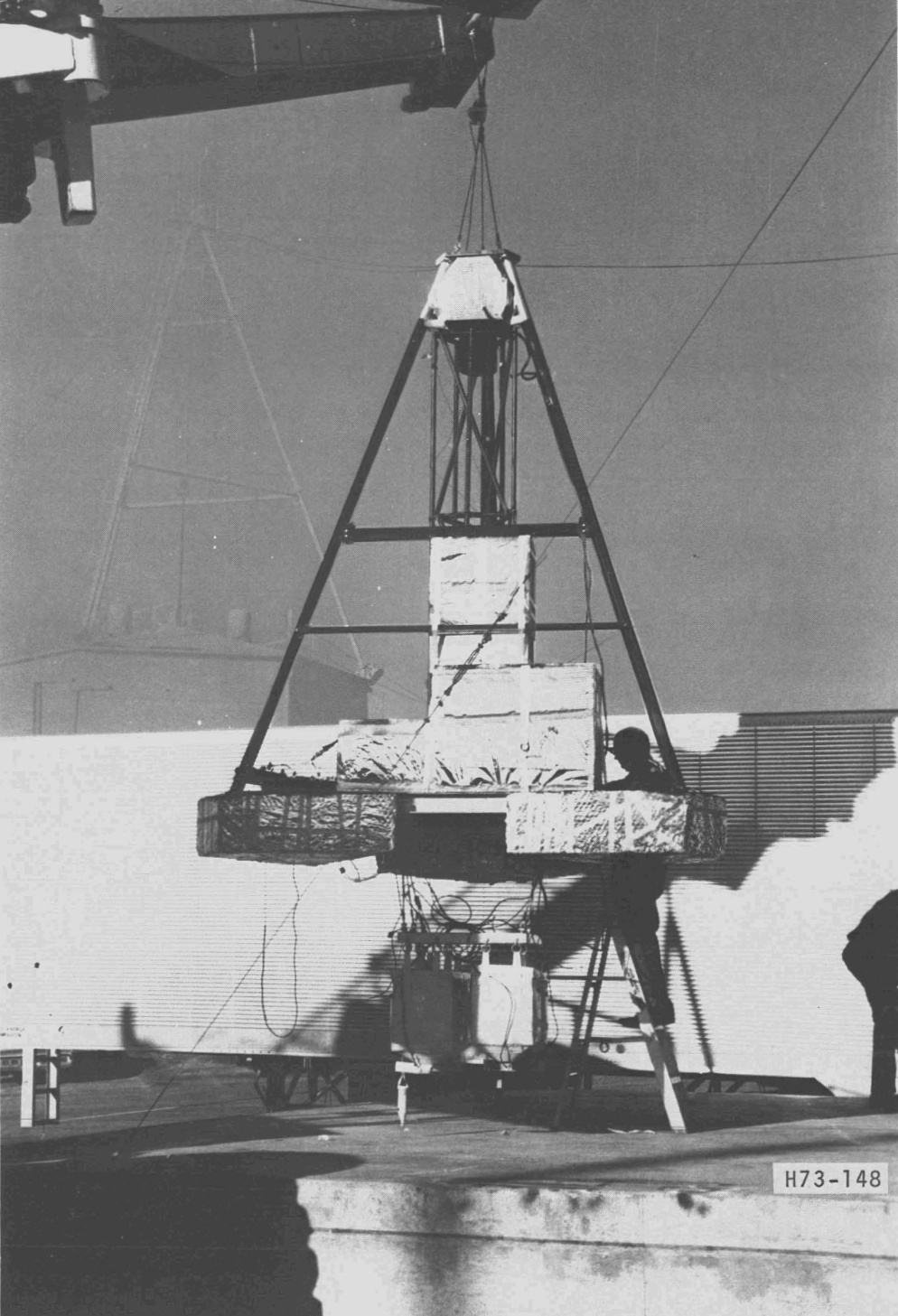
In the image at left we can see the gondola with the instruments during pre-flight tests (click to enlarge). The payload consisted of four main subsystems: the ozone measurement instrument, the nitric oxide measurement instrument, the smoke generator and the nitric oxide release system.
The ozone measurement instrument operated on the White Cell principle, using multiple reflections between mirrors spaced two meters apart to obtain a 100-meter optical path. Two ultraviolet wavelengths were alternately passed through the cell: one absorbed by ozone in proportion to its concentration, and another used as a reference. The mirrors were supported by an invar tubular structure with low thermal expansion to maintain alignment in extreme conditions. The ultraviolet source lamp and photomultiplier detector were housed in an electronic control box on top of the structure. This box also contained a filter wheel driven by a rotary solenoid that alternated the two bandpass filters, a low-noise amplifier, and telemetry electronics to send real-time data to the ground.
The nitric oxide measurement instrument used an ionization chamber on which Lyman-alpha radiation ionized nitric oxide molecules, generating a current between two charged plates proportional to the nitric oxide concentration. Two alternating lamps (a hydrogen lamp producing strong Lyman-alpha radiation and a xenon lamp without that emission) allowed background current correction. A high-impedance preamplifier near the detector plates filtered and conditioned the ion current before telemetry. By electronically comparing the signals from both lamps, the system isolated the true nitric oxide ion signal from unwanted photoelectron noise.
The smoke generator consisted of 20 cartridges and their launchers, controlled electronically. Each launcher ejected a cartridge away from the payload to prevent contamination, producing a visible puff of smoke to be photographed from the ground with Questar telescopes and Nikon 35 mm cameras. The time-lapse photos were intended to measure pollutant dispersion rates in the stratosphere.
The nitric oxide release subsystem injected nitric oxide gas from a storage bottle into the ozone cell at five preselected flow rates, allowing researchers to directly observe reaction rates between nitric oxide and ozone by monitoring changes in the 2537 Angstrom absorption signal.
All these elements were mounted in a triangular-based tubular pyramid gondola that supported all the instruments. It provided an open framework to allow circulation of air, ozone, and nitric oxide, minimized blockage of sunlight, and held the two-meter-long vertical White Cell. The structure also carried the command and telemetry unit, ballast containers, and crushable cardboard pads in the bottom to absorn the landing shock.
The entire payload weighed about 2,255 pounds, including 1,400 pounds of lead shot as ballast for altitude control.
Details of the balloon flight
Balloon launched on: 10/17/1973
Launch site: National Scientific Balloon Facility (NSBF), Palestine, Texas, US
Balloon launched by: National Scientific Balloon Facility (NSBF)
Balloon manufacturer/size/composition: Zero Pressure Balloon Winzen 107.321 m3 (38.10 Microns - Stratofilm)
Flight identification number: 791P
End of flight (L for landing time, W for last contact, otherwise termination time): 10/18/1973
Balloon flight duration (F: time at float only, otherwise total flight time in d:days / h:hours or m:minutes - ): F 3 h
Landing site: Near Scooba, Missisippi, US
Payload weight: 1168 Kgs.
The flight was performed from the National Scientific Balloon Facility in Palestine, Texas on October 17, 1973. Launch was in the late evening with enough helium in the balloon to go up to the first float altitude of 30 km. It was intended to have a 2224 hour flight but the winds aloft were fast enough that the payload was out of range before dawn the next day. After the first float altitude, a second altitude was established at 26 km. During the descent to the third altitude, commands to the balloon control were erratic, resulting in a lower altitude than intended. The third float altitude was allowed to increase so commands would not have to be sent. At dawn the payload was already 190 miles down range and out of effective photographing and command range from the launch site. Two photographing crews followed the payload during the night, but lost ground after dawn when the wind aloft speed increased. The crews set up and attempted to take photographs of the smoke puffs which were released on commands from a chase airplane, but due to the distance no smoke was seen. During the early night float altitudes, ozone was detected and the subsequent calculations indicated the instrument was measuring the expected concentrations. Due to the high wind aloft difficulty, only about one-fourth of the scientific objectives were obtained. The payload was separated from the balloon at approximately 9:30 on October 18th and was recovered in good condition near Scooba, Mississippi.
External references
- Final Report NRL/ATM program 620-225 June 7, 1974 Large Angle and Spectrometric Coronagraph Experiment (LASCO) website
- National Scientific Balloon Facility Annual Report FY 1974 National Center for Atmospheric Research, December 1974
StratoCat is an independent, non-commercial project maintained to preserve and share the history of scientific and stratospheric ballooning. If you find the site useful, you can help keep it running with a small donation toward its operating costs. Every contribution, even the equivalent of a cup of coffee, is greatly appreciated.