
Purpose of the flight and payload description
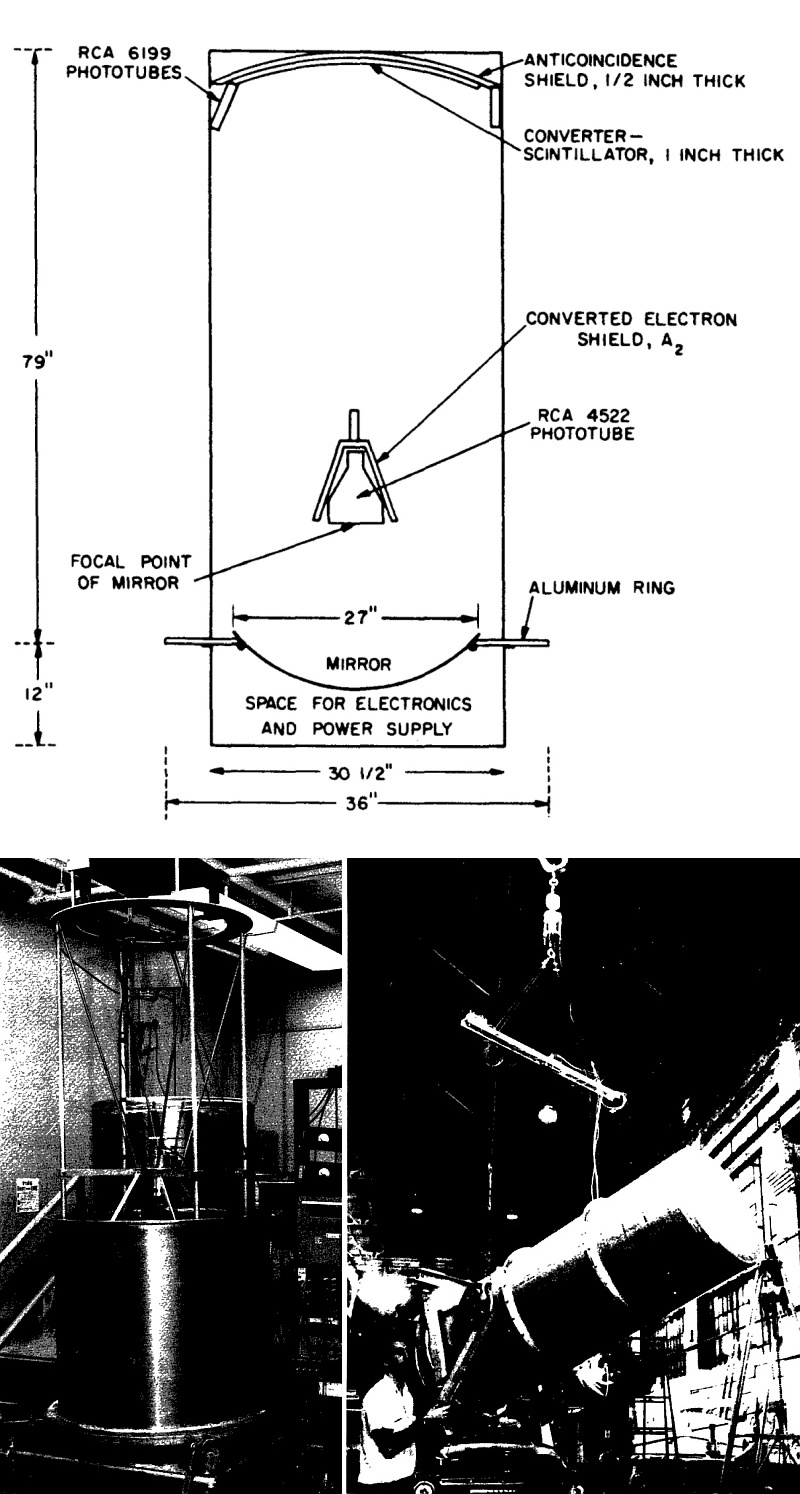
The objective of the flight was to study atmospheric and extraterrestrial gamma radiation in the energy range from 10 to 100 MeV by employing a GAS-CERENKOV DETECTOR designed specifically for high-altitude balloon flights. The primary scientific goals were to measure the atmospheric gamma-ray flux above 15 MeV and to establish upper limits on the gamma-ray flux from celestial sources such as the Crab Nebula and M87. The project, developed by the Smithsonian Astrophysical Observatory and the Harvard College Observatory, aimed to achieve measurements with a detector that combined a large sensitive area, good angular resolution, and effective background rejection, all within a relatively simple structural and operational design.
In the image at left we can see a schematic view of the instrument and a picture of the external structure during test in the laboratory (click to enlarge).
The detector worked by having incident gamma rays interact in a 1-inch-thick polystyrene scintillator slab called the converter-scintillator. This slab converted gamma rays via pair production or Compton scattering, producing electrons which then emitted Cerenkov radiation when entering a gas volume beneath the slab. The design used the scintillator itself as the converter, rather than a separate lead layer, to reduce multiple scattering of low-energy electrons and preserve angular resolution. photomultiplier tubes detected both the scintillation and Cerenkov light, with events identified through coincidence logic between scintillation signals and Cerenkov light signals, while anticoincidence shielding excluded charged particle events.
The Cerenkov light was focused by a large, metallic, rhodium-coated mirror onto a 5-inch RCA 4522 photomultiplier tube. The mirror had a focal length of 24 inches and was originally a surplus searchlight mirror, selected for practical reasons despite its weight. The Cerenkov radiator was filled with propane gas, chosen for its low electron multiple scattering and sufficient light emission, offering an optimal balance between detection efficiency and angular resolution. The gas pressure was adjustable to vary the energy threshold during flight, enabling the measurement of gamma rays above different energy levels.
The detector was enclosed in a lightweight aluminum canister designed to hold differential pressures up to one atmosphere and to withstand the vacuum of space during preparation. The frame consisted of aluminum support rods connecting the converter-scintillator at the top to the mirror and photomultiplier at the bottom. The structure included three sections to allow assembly and disassembly without tilting the detector. Electronics mounted on a plate near the base controlled data acquisition and signal processing.
The electronics system included commercial fast-timing modules that processed signals from the photomultipliers. It detected gamma rays via coincidence logic, rejected charged particles with anticoincidence logic, performed pulse-height analysis with an in-house four-channel pulse-height analyzer, and monitored photomultiplier rates and housekeeping parameters such as gas pressure, temperature, and battery voltage. Information was transmitted via telemetry to the ground, and the system was designed for low event rates to avoid data pile-up.
A pointing system was implemented based on a design from the University of Southampton, using a motorized azimuth drive, magnetometers, and a sun sensor to achieve azimuth and elevation control. Orientation was corrected by ground command using non-latching relays. Magnetometers provided coarse direction, while a pendulum-driven potentiometer measured elevation. The system allowed the detector to be steered with a few degrees of accuracy despite rotational and oscillatory motions of the balloon platform.
Details of the balloon flight
Balloon launched on: 9/29/1970 at 10:54 UTC
Launch site: NCAR National Scientific Balloon Flight Station, Palestine, Texas, US
Balloon launched by: NCAR National Scientific Balloon Flight Station
Balloon manufacturer/size/composition: Zero Pressure Balloon Raven 5.000.000 cuft (0.75 mil. X-124)
Flight identification number: 584P
End of flight (L for landing time, W for last contact, otherwise termination time): 9/29/1970 at 23:00 UTC
Balloon flight duration (F: time at float only, otherwise total flight time in d:days / h:hours or m:minutes - ): F 9 h 50 m
Landing site: In Hobart, Oklahoma, US
Payload weight: 996 lbs.
The balloon was launched from the NCAR scientific balloon base at Palestine, Texas at 11:00 UTC on 29 September, 1970. The net weight, including telemetry and a piggy-back experiment, was 600 lbs. The balloon reached an altitude of 116,100 ft. at 13:20 UTC, gradually rose to 117,800 ft. at 16:30 UTC, and remained above 117,000 ft until the flight was terminated at 23:00 UTC.
No data was collected after 21:15 UTC, when battery power ended, but FAA clearance problems delayed cutdown nearly two hours. Telemetry contact was strong throughout the flight: the data were marked by only a few noise bursts, and the pointing system responded to all ground commands. The package landed on top of the highest hill in the Indian reservation near Hobart, Oklahoma. Dense outcroppings of vertical rock strata made access by even four-wheel drive vehicle impossible, and cacti and rattlesnakes made approach on foot difficult. Despite an helicopter rescue effort carried out by the U.S. Army, the pointing system was lost to a band of scavenging locals. The F.B.I. was called in but decided that the theft didn't deserved further investigation. This led to the plan -which never materialized- that on future missions, one of the science team members would accompany the recovery team in the reconnaissance plane, equipped with parachute gear and commando equipment, to protect the gondola from marauding locals after landing.
The detector used in this first balloon flight had a smaller area and was pointed for about 2 hours each at the Crab nebula and M87. Equal lengths of off-source time were also accumulated.
External references
- A Gas-Cerenkov Telescope Experiment to Observe Cosmic Gamma Rays SAO Special Report #335 (1971)
- Gamma Ray Astronomy above 15 MeV Using a Gas Cerenkov Detector 12th International Conference on Cosmic Rays, 1971. Volume 1., p.56
- NCAR Scientific Balloon Facility Annual Report, 1970 National Center for Atmospheric Research, February 1971
StratoCat is an independent, non-commercial project maintained to preserve and share the history of scientific and stratospheric ballooning. If you find the site useful, you can help keep it running with a small donation toward its operating costs. Every contribution, even the equivalent of a cup of coffee, is greatly appreciated.