
Purpose of the flight and payload description
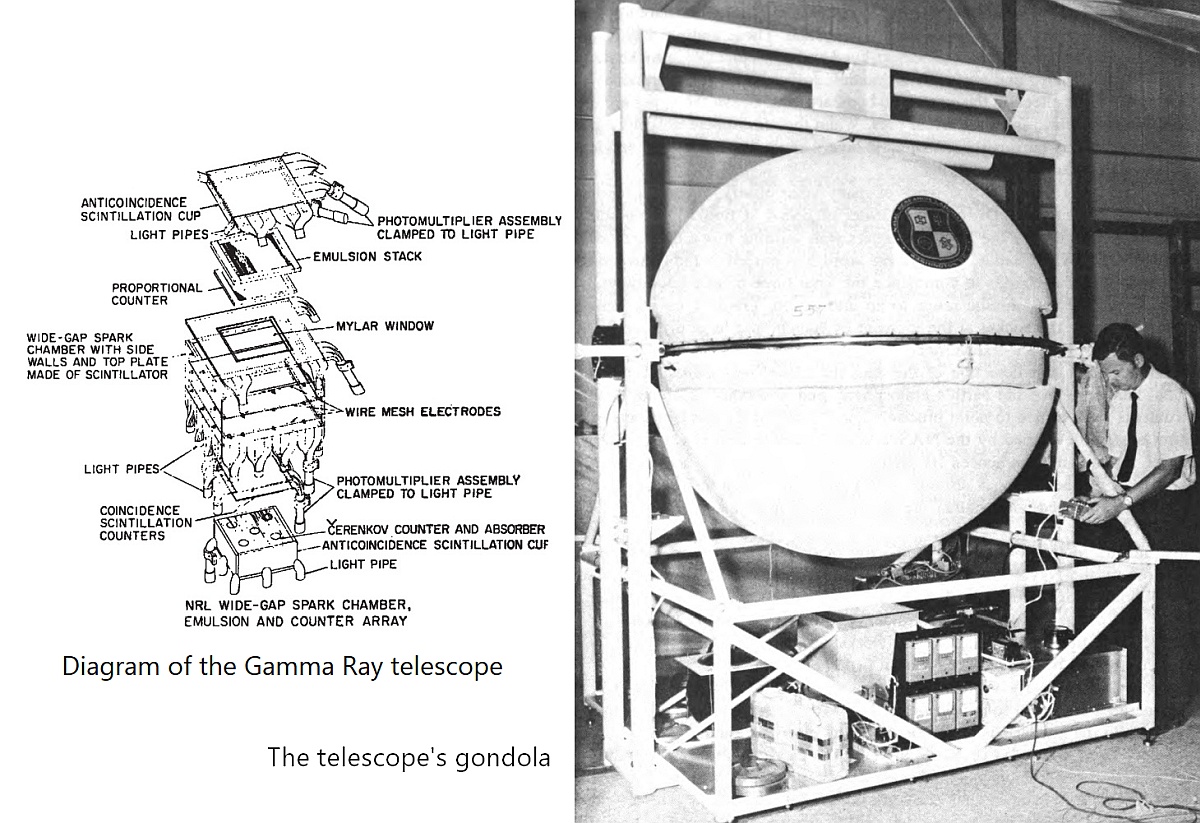
The objective of the flight was to detect pulsed gamma radiation from celestial sources such as the Crab Pulsar using a GAMMA-RAY TELESCOPE operating within an energy range of approximately 10 to 200 MeV. The instrument was developed by the Laboratory for Cosmic Ray Physics at the Naval Research Laboratory (NRL) with the goal of opening a then new field in astronomy by observing discrete cosmic gamma-ray sources. Gamma rays are uniquely valuable because they travel in straight lines, pointing directly back to their origin. Beyond the search for specific sources like the Crab Nebula, the NRL scientists also aimed to detect and measure the diffuse, general background of gamma radiation pervading space.
In the image at left we can see the gondola containing the instrument (click for more details). It incorporated a stack of nuclear emulsions serving as a converter, where gamma rays interacted to produce electron pairs or Compton recoil electrons. These electrons then passed through a multi-wire proportional counter and a pair of plastic scintillation counters. An upper energy limit was imposed by a five-inch thick block of clear plexiglas positioned below the scintillation counters, which acted as both a stopper for the electrons and a Cerenkov counter to reject upward-moving gamma rays that might convert within it.
Phototubes embedded in this block detected Cerenkov light reflected from a diffuse reflector above. Charged particles were vetoed by plastic scintillators covering nearly 4 pi solid angle. Upon gamma-ray detection, a wide-gap spark chamber comprising two four-inch gaps, was triggered, with sparks recorded in 90° stereo on 35mm film. To minimize material between the emulsion and spark chamber, thus reducing electron scattering, the design used thin mylar windows and transparent wire-mesh electrodes in both the proportional counter and spark chamber.
The telescope's orientation was controlled by an altazimuth system with an on-board computer, capable of pointing within 1.5º of a target, using a fine magnetometer and a star-field camera for accurate positioning.
Details of the balloon flight
Balloon launched on: 9/24/1969 at 23:58 CDT
Launch site: NCAR National Scientific Balloon Flight Station, Palestine, Texas, US
Balloon launched by: NCAR National Scientific Balloon Flight Station
Balloon manufacturer/size/composition: Zero Pressure Balloon Winzen 10.600.000 cuft (0.7 mil.) 1 Cap. (0.7 Mil.) Stratofilm
Balloon serial number: SF 305.86-070-NSC-08
Flight identification number: 501P
End of flight (L for landing time, W for last contact, otherwise termination time): 9/25/1969
Balloon flight duration (F: time at float only, otherwise total flight time in d:days / h:hours or m:minutes - ): F 6 h 30 m
Landing site: In McComb, Mississippi, US
Payload weight: 1702 lbs.
External references
- NCAR Scientific Balloon Facility Annual Report, 1969 National Center for Atmospheric Research, January 1970
- Search for Pulsed Gamma-Rays from the Crab 12th International Conference on Cosmic Rays, Volume 1., p.45
If you consider this website interesting or useful, you can help me to keep it up and running with a small donation to cover the operational costs. Just the equivalent of the price of a cup of coffee helps a lot.