
Purpose of the flight and payload description
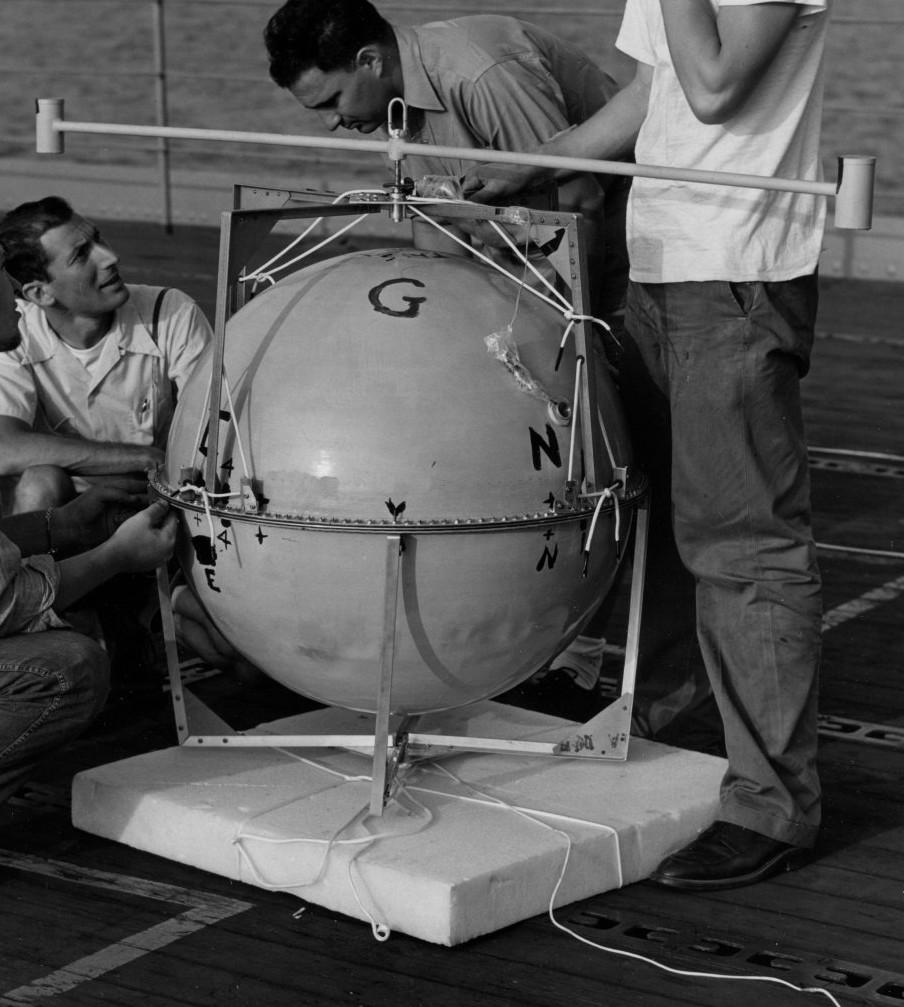
The objective of the flight was to measure the intensity and angular distribution of heavy primary cosmic-ray nuclei at the geomagnetic equator, determine their charge distribution, and measure their flux at the top of the atmosphere. The experiment was conducted as part of Project Churchy, a cosmic-ray expedition to the Galápagos Islands, near the geographic equator. The instrument was developed and operated by researchers from the Department of Physics at the University of Minnesota, Minneapolis, Minnesota, with the expedition supported by the Office of Naval Research.
In the image at left we can see the sealed sphere containing the nuclear emulsions while being prepared for flight (click to enlarge). The detector assembly comprised six stacks of nuclear emulsions, each measuring 4 × 10 inches. Each stack contained three emulsion plates, each 600 microns thick. The stacks were arranged horizontally along the equatorial plane of a 30-inch spherical aluminum enclosure that was pressurized and insulated. The emulsions maintained a horizontal orientation to facilitate measurements of the azimuthal distribution of incoming cosmic rays.
The nuclear emulsions recorded the trajectories of charged particles passing through the detector. Their tracks were examined to determine the directions of incidence and identify the particles' charges. Charge identification relied on counting delta rays along the tracks. For relativistic particles, the density of delta rays was proportional to the square of the nuclear charge, allowing the nuclei to be classified according to charge. The scanning procedure was designed to detect nuclei with charges equal to or greater than six, distinguishing the carbon, nitrogen, oxygen, and fluorine group (CNOF) from nuclei with atomic numbers of ten or greater. Longer tracks, produced by particles entering at large zenith angles, provided improved charge resolution because the delta rays could be counted over a greater distance within the emulsion stacks.
An orientation system maintained the emulsion planes in a prescribed direction relative to the Earth's magnetic field. It consisted of a compass and two photocells arranged so that a deviation from the required orientation illuminated one of the photocells. The resulting signal was amplified and used to operate the orienting motor through a differential relay, switching the motor on and off to correct the alignment.
The spherical enclosure was oriented using two weights suspended from the ends of a six-foot boom. A recording mechanism photographed a pressure gauge, a watch, a level, a thermometer, and a compass to document the flight conditions and apparatus orientation. The compasses were positioned to avoid mutual interference.
Details of the balloon flight
Balloon launched on: 9/11/1953 at 6:35 local time
Launch site: USS Currituck (AV-7)
Balloon launched by: General Mills Inc.
Balloon manufacturer/size/composition: Zero Pressure Balloon General Mills 85
Flight identification number: GMI 1081
End of flight (L for landing time, W for last contact, otherwise termination time): 9/11/1953 at 15:20 local time
Balloon flight duration (F: time at float only, otherwise total flight time in d:days / h:hours or m:minutes - ): 7 h 55 m
Landing site: In Pacific Ocean at 1º 21.1' S 95º 10.5' W
Campaign: OPERATION CHURCHY
Payload weight: 145 lbs
External references
- Heavy Primary Cosmic Radiation at the Equator Phys. Rev. 103, 1075
- Project Skyhook - Final report projects 85022 and 85023 General Mills Mechanical Division - Report Nº 1434 - July 1955
StratoCat is an independent, non-commercial project maintained to preserve and share the history of scientific and stratospheric ballooning. If you find the site useful, you can help keep it running with a small donation toward its operating costs. Every contribution, even the equivalent of a cup of coffee, is greatly appreciated.