
Purpose of the flight and payload description
The objective of the flight was to measure the specific ionization produced by individual particles and distinguish between protons and helium nuclei using a a balloon-borne cosmic-ray detector designed at the Bartol Research Foundation of The Franklin Institute, Swarthmore, Pennsylvania. The flight was part of Operation Churchy an expedition to the equatorial zone carried out abord the seaplane tender USS Currituck by the Office of Naval Research of the U.S. Navy.
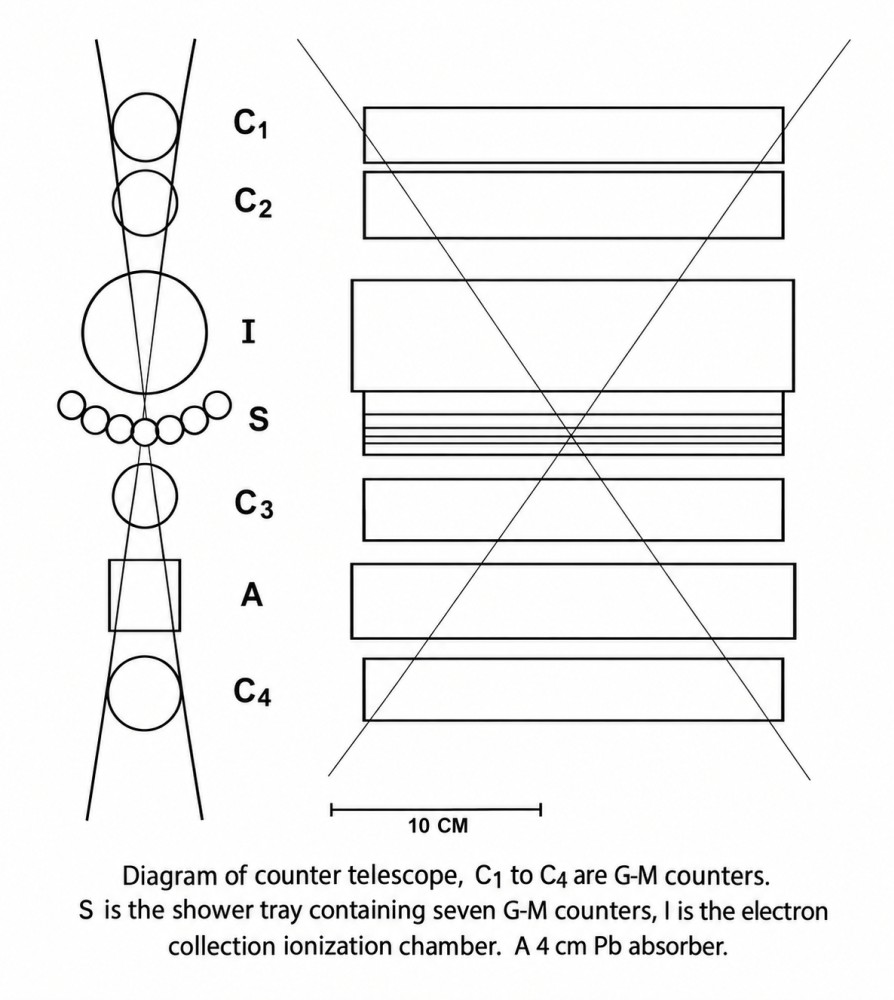
In the image at left we can see a schematic diagram of the location of each element of the payload (click to enlarge). It consisted of a detector telescope, an ionization chamber, a shower detector, electronic amplification and pulse-analysis circuits, and a recording system.
The telescope comprised four a GeigerMüller (G-M) counters, designated C1C4, with glass walls and Aquadag cathodes. Each counter had effective dimensions of 17.8 cm by 3 cm. Coincidences between the four counters defined the telescopes acceptance solid angle. The counters were filled with a gas mixture of 86% argon and 14% butane at a pressure of 100 mm Hg, and their coincidence circuits had a resolving time of 10 microseconds. A 4 cm thick lead absorber could be placed at position A in the telescope to suppress slow protons that might otherwise be confused with relativistic helium nuclei.
The ionization chamber used fast electron collection to produce pulses proportional to the ionization deposited by a traversing particle. It was filled with argon of 99.9% purity at a pressure of 300 psi. A 1000 V battery supplied the chamber and G-M counters.
The shower detector, designated S, consisted of a tray containing seven G-M counters. A coincidence between two or more shower counters and the four telescope counters identified events involving showers or multiple particles. The active volumes of adjacent shower counters were separated by approximately 1.6 mm, corresponding to the thickness of their envelopes.
The ionization-chamber signal passed through a three-stage linear amplifier. A 6AK5 input tube reduced the noise to less than one-tenth of the average sea-level meson pulse. The output stage used a push-pull circuit. Amplified pulses had a rise time of approximately 10 microseconds and a decay time of about 100 microseconds.
A three-inch cathode-ray tube displayed the pulses. Coincidence selectors, a sawtooth sweep generator, a pulse-height discriminator, timing gates, and a delay line controlled the display. Each four-counter coincidence intensified the screen spot for 50 microseconds. A 10-microsecond delay allowed the sweep and intensifier to start before the signal reached the vertical plates. When a shower was detected, a clamping circuit blocked the sweep, producing a vertical pulse trace instead of the normal swept display.
A camera recorded the cathode-ray tube display on continuous 16 mm film. A thermometer, clock, and mercury manometer measuring pressures from 0 to 70 mm Hg, were also recorded. Instrument readings were marked on the film every five minutes, with additional one-minute markers. An external aneroid barometric switch activated a light at predetermined pressure intervals when the pressure fell below the manometers range.
The apparatus, oscilloscope, and camera were housed in a sealed, 24-inch-diameter aluminum sphere maintained at atmospheric pressure to prevent high-voltage corona and protect the film in the event of a water landing. The gondola was wrapped in three loose Pliofilm bags for insulation.
Details of the balloon flight
Balloon launched on: 9/10/1953 at 7:47 local time
Launch site: USS Currituck (AV-7)
Balloon launched by: General Mills Inc.
Balloon manufacturer/size/composition: Zero Pressure Balloon General Mills 85
Flight identification number: GMI 1080
End of flight (L for landing time, W for last contact, otherwise termination time): 9/10/1953
Balloon flight duration (F: time at float only, otherwise total flight time in d:days / h:hours or m:minutes - ): +8 h
Landing site: Failure of the timer. Payload not recovered
Campaign: OPERATION CHURCHY
Payload weight: 152 lbs
External references
- Composition of the Primary Cosmic Radiation at?=10°N Phys. Rev. 96, 1391 (1954)
- Project Skyhook - Final report projects 85022 and 85023 General Mills Mechanical Division - Report Nº 1434 - July 1955
StratoCat is an independent, non-commercial project maintained to preserve and share the history of scientific and stratospheric ballooning. If you find the site useful, you can help keep it running with a small donation toward its operating costs. Every contribution, even the equivalent of a cup of coffee, is greatly appreciated.