
Purpose of the flight and payload description
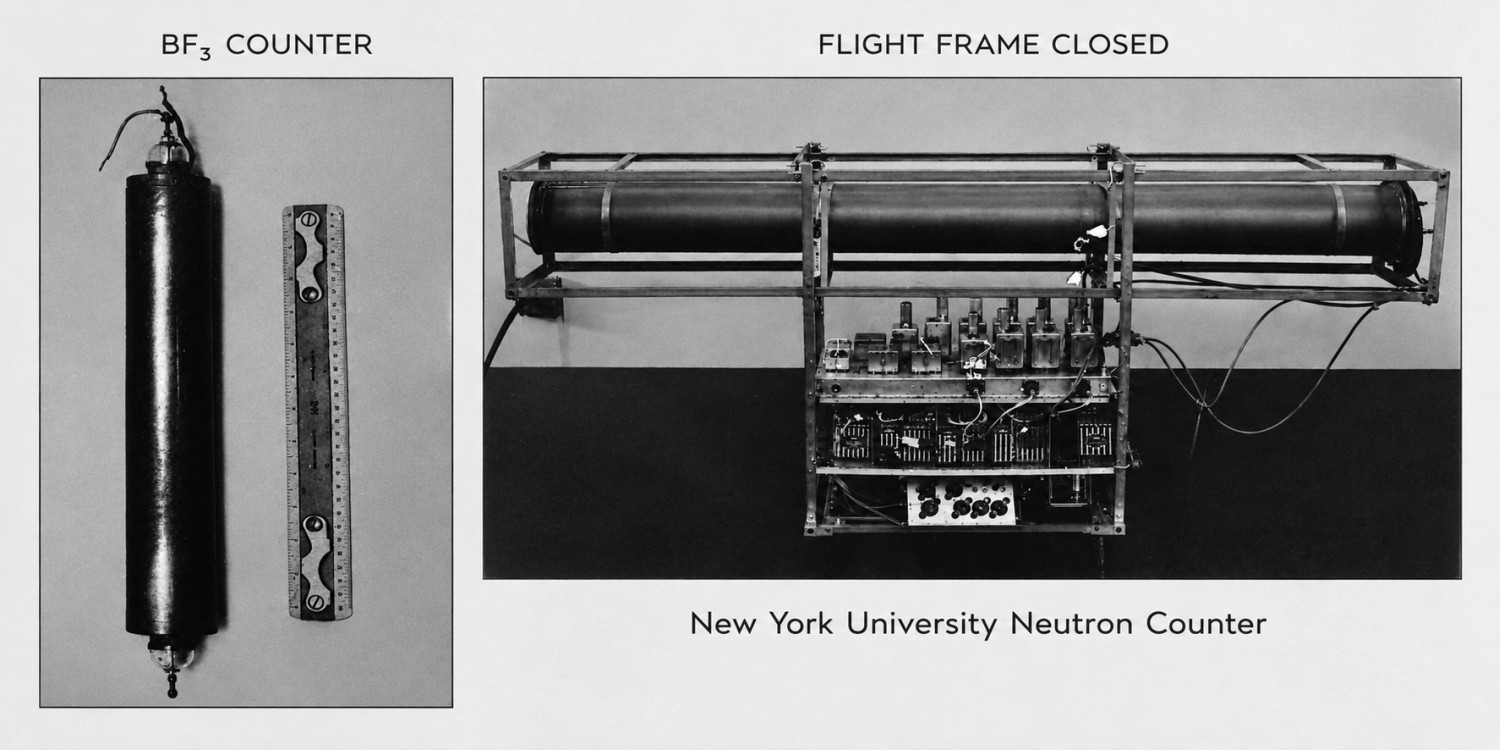
The objective of the flight was to measure atmospheric neutron intensities using a balloon-borne NEUTRON COUNTER designed by the Research Division of the College of Engineering of the New York University in the early 1950s. The instruments core consisted of two boron trifluoride (BF3) proportional counters, identical in construction and filled to the same gas pressure, but differing in isotopic composition. One counter contained isotopically enriched BF3 with a high proportion of boron-10 (10B), while the other contained isotopically depleted BF3. This configuration enabled neutron-induced events to be distinguished from background signals associated with cosmic-ray interactions and other sources.
In the picture at left we can see one of the detectors in its container frame (click for more details). The detection principle was based on the interaction of neutrons with boron-10 nuclei in the BF3 gas. These interactions produced electrical pulses in the proportional counters, which were collected at the central wires. The outer cylinders were maintained at a high negative voltage, while the central wires operated near ground potential. The resulting pulses were transferred through hermetic electrical feedthroughs to the signal-processing electronics.
The two counters were connected to a switching system operated by a program motor and a cam-driven microswitch. This mechanism alternately connected each counter to the readout electronics for predetermined intervals. The switching system also generated distinct signals identifying the active counter, allowing measurements from both detectors to be distinguished in the transmitted data.
The electronic readout chain comprised a cathode-follower preamplifier, a two-stage resistance-coupled amplifier, a pulse-scaling circuit, and a trigger circuit. The preamplifier provided impedance matching between the proportional counters and the amplifier. The amplifier increased the pulse amplitude, while the scaling circuit reduced the pulse rate presented to the trigger stage. The trigger circuit actuated a blocking oscillator that modulated the radio transmitter, enabling the detection events to be recorded at ground stations. The transmitted signal was received and recorded using a radio receiver connected to a pen oscillograph.
The counters and high-voltage components were enclosed in a pressure-tight assembly to prevent corona discharges under the reduced atmospheric pressures encountered at high altitudes, which could otherwise produce spurious counts. The assembly incorporated sealed connections for the high-voltage and signal lines. The instrument was mounted on a welded aluminium flight frame, with the counters aligned longitudinally to minimize the solid angle subtended by one counter upon the other and to reduce the amount of scattering material above the detectors. The electronic components were individually mounted to facilitate replacement during field operations, and the circuitry was enclosed in copper screening to reduce external electrical interference.
Details of the balloon flight

Balloon launched on: 8/27/1952 at 10:52 EST
Launch site: USCGC Eastwind (WAGB 279) anclado en la Bahia de Baffin entre Groenlandia y el NE de Canada
Balloon launched by: General Mills Inc.
Balloon manufacturer/size/composition: Zero Pressure Balloon Winzen 73'
Flight identification number: GMI 954
End of flight (L for landing time, W for last contact, otherwise termination time): 8/27/1952 at ~ 15:00 hrs
Balloon flight duration (F: time at float only, otherwise total flight time in d:days / h:hours or m:minutes - ): 4.7 h
Landing site: Payload lost at sea.
The balloon was launched at 10:52 a. m. EST on August 27, 1952. The geographic coordinates of the ship at the time of launching were 77° 40'N and 72° 37'W. A single Winzen Research 75 foot plastic balloon was used for this flight. The balloon rose with a velocity of about 750 ft/min to 32,000 ft. At this altitude it slowed down to about 300 ft/min and continued to rise to an altitude of 43,000 ft, at which altitude it leveled off. Theoretically, the balloon should have risen to an altitude of about 93,000 ft; however, it is believed that a small tear in the polyethelene plastic caused the balloon to level off at the much lower altitude. Also wet snow accumulating on the balloon (launching was attempted in a snowstorm) could be contributed to the lower altitude. The balloon floated at 43,000 ft for about 30 minutes and then began a slow descent to 11,000 ft where a clock operated squib caused the gondola to be released on a parachute. The flight lasted a total of 4.8 hours and data was recorded throughout this time. While the flight did not reach the altitude of the neutron intensity maximum, nevertheless, the slow rate of descent did yield good statistics for the data on the exponential portion of the neutron intensity curve.
External references
- BalloonBorne Instrumentation for Neutron Detection Review of Scientific Instruments 21, 529 (1950)
- Final Report Project 85006 General Mills - 1953
- High Altitude Cosmic Ray Neutron Intensity Variations Prepared for Office of Naval Research, Nuclear Physics Branch, Washington, D.C., Contract No. N6 onr 279 TO 2
- High-Altitude Cosmic-Ray Neutron Density at the Geomagnetic Pole Phys. Rev. 97, 1276 (1955)
StratoCat is an independent, non-commercial project maintained to preserve and share the history of scientific and stratospheric ballooning. If you find the site useful, you can help keep it running with a small donation toward its operating costs. Every contribution, even the equivalent of a cup of coffee, is greatly appreciated.