
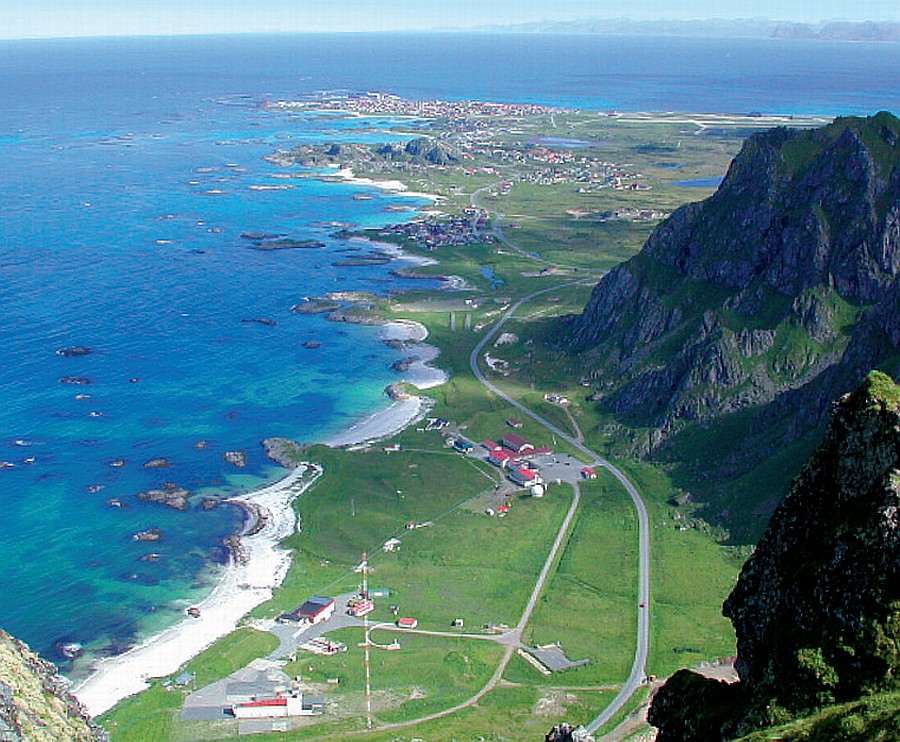
The island of Andoya is part of the Vesterålen Islands and is located in the northern coast of Norway. It belongs to the Nordland county and have a surface of 489 square kilometers. It's name means "Island of the Ducks" due to the extensive flocks of these birds that overwhelm their cliffs and rocky coasts each spring.
The beginnings of the scientific activity there can be traced back to March 1960, when the Norwegian Ministry of Defense ordered the construction of a missile range, authorizing the launching of small American vectors devoted to geophysical and astrophysical research. The first launch (a Norwegian-Danish rocket) took place on August 18th, 1962, from a precarious installation located about 3 km east of the town of Andennes.
At first the facility comprised only a few containers acting as houses and laboratories, wich remained occupied only during the time in which the campaigns were developed.
Although the first launches of sounding rockets were of American origin, as of 1966 the European Space Research Organisation (ESRO) wich was the precursory of the actual European Space Agency (ESA) put their eyes in Andoya. Thus while awaited the end of the construction of their own facility in Sweden (ESRANGE) the agency performed several scientific firings there using Centaur and Dragon rockets.
First balloon launches
The first stratospheric balloon launches in Andoya were performed in 1962, sponsored by the Solar Particles and Radiations Monitoring Organization (SPARMO) a multinational scientific effort originally established for the purpose of coordinating balloon recordings of solar particle radiation. The flights (which were performed simultaneously with similar ones launched from Kiruna, Sweden) had the aim of measuring bremsstralhlung X-rays produced by electron precipitation during the so called Slowly Varying Ionospheric Absorption events. These experiences were repeated in successive years until 1967 at an avergae pace of two or three launches per year.
Also in 1964, throught an agreement signed between the Norwegian Space Commission and the Bergen University were performed several launches within the framework of POCIBO (Polar Circling Balloon Observatory), a scientific program developed for the International Year of the Quiet Sun to perform a wide range of measurements in the Arctic zone. Experiments carried by the balloons included low-energy proton detectors, ion chambers, geiger counters, scintillation counters, air-temperature and radiation sensors, and devices to perform electric-field and ozone measurements. The balloons were aimed to make long duration flights over Greenland and the Islands of the north of Canada. Complementarily, several other balloons were launched from other locations as Point Barrow in Alaska and Fort Churchill in Canada as part of the project.
The POCIBO balloon flights were flown from the Andennes airfield in July that year. Although the launches were carried out succesfully, the 4 missions were a failure due to structural problems in the balloons which in most cases never reached float altitude. Nevertheless, is worth to emphasize that this was the first organized attempt to use a stratospheric balloon to perform a transatlantic flight.
By 1970's decade, several balloon campaigns were performed from various points in Scandinavia, including in some cases Andoya. These campaigns were aimed to study the auroral phenomena by performing long duration flights over the Atlantic. In many of these campaigns, althought there were no launches made from Andoya, the advantageous location of the island was of primary importance to locate telemetry stations to follow the balloons launched from other locations.
Balloons in the Andoya Space Center era
Many of the balloons launched during the decades of 80's and mainly the 90's were flown from the installations of the former Andoya Rocket Range, nowadays denominated Andoya Space Center (ASC). The facility is responsible for all sounding rocket and scientific balloon operations performed from Norwegian territory. It is a limited company owned 90% by Norway's Ministry of Trade and Industry and 10% by Kongsberg Defence Systems. The ASC complex in Andoya is located on the coast of the island in one narrow strip between the sea and a small mountainous chain that crosses all its geography (picture above)
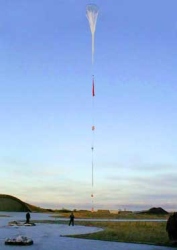
The missions carried out there in 90's decade were part of European arctic studies on the ozone depletion problem like SESAME, THESEO and THESEO 2000 under operative control of CNES which also provided launch capabilities as the range have not balloon launch dedicated facilities or hardware.
ASC has also expanded their operational range managing another rocket launch site located in Ny-Alesund, on the Svalbard Islands (78º North latitude). Starting in 2003, several balloon launches were performed under management of the ISTAR Group from the United States, under contract with the Italian Space Agency (ASI). This activity was aimed to establish a permanent balloon launch facility denominated Nobile/Amundsen Stratospheric Balloon Center which would allow to perform circumpolar long duration flights of heavy payloads. The project for the future base first contemplated the built of a dedicated facility near the town of Longyearbyen, which was presented in several international meetings. However, once the first test were launched from the Longyearbyen airport, the project changed: instead of building a new base the new facility would be integrated with the airport infrastructure. However, the years passed by and no great progress was made.
Althought the long duration balloon project was presented in the ASC institutional brochure (edited in 2015), the present status of the project is unknown. Although, several launches were made under operative control of the ISTAR group under contract, at some point their interest in balloon activities seemed to decline as several missions planned to be performed from Svalbard in the near future were simply erased from their schedule.
Recent activity
In 2018, the Andøya Spaceport project was initiated to become Europe's first launch base for small satellites, mainly for Earth observation and communications. The Norwegian government invested in the project, expecting commercial returns. In 2020, Andøya Space has partnered with Germany's Isar Aerospace, granting the company exclusive access for up to twenty years to one launch pad, while Andøya provides the necessary infrastructure and facilities. A new launch pad was built near Nordmela and first used during a failed attempt by Isar of its Spectrum Rocket. A smaller launch pad located nearby was used in August 2025 to perform a single stratospheric balloon launch which marked the return of Andoya Space to the use of balloons in more than 25 years.
Although not related to the Andoya Space activity, in 2021, the US company Aerostar conducted several high-altitude balloon flights from Andenes airport during the Thunder Cloud artillery exercise led by the 41st Field Artillery Brigade in northern Norway. The Thunderhead balloon systems, launched to altitudes of 60,00072,000 feet, provided weather data and sea target coordinates to ground troops, enabling them to fire M31 guided rockets with ranges over 40 miles. This exercise marked the first use of balloons to transmit target coordinates for attacks using the Multiple Rocket Launch System. Web site: Andoya Space - https://andoyaspace.no
Balloons launched near Andennes
| Date | Hour | Flight Duration | Experiment | Payload landing place or cause of the failure |
|---|---|---|---|---|
| 9/13/1962 | --- | X-RAY DETECTOR | --- No Data --- | |
| 9/13/1962 | --- | X-RAY DETECTOR | --- No Data --- | |
| 9/15/1962 | --- | X-RAY DETECTOR | --- No Data --- | |
| 9/16/1962 | --- | X-RAY DETECTOR | --- No Data --- | |
| 7/23/1963 | --- | X-RAY DETECTOR | --- No Data --- | |
| 9/15/1963 | --- | X-RAY DETECTOR | --- No Data --- | |
| 9/16/1963 | --- | X-RAY DETECTOR | --- No Data --- | |
| 9/17/1963 | --- | X-RAY DETECTOR | --- No Data --- | |
| 7/8/1964 | --- | POCIBO 5 (Polar Circling Balloon Observatory # 5) | --- No Data --- | |
| 7/12/1964 | --- | POCIBO 6 (Polar Circling Balloon Observatory # 6) | --- No Data --- | |
| 7/19/1964 | --- | POCIBO 7 (Polar Circling Balloon Observatory # 7) | --- No Data --- | |
| 7/23/1964 | --- | POCIBO 8 (Polar Circling Balloon Observatory # 8) | --- No Data --- | |
| 8/6/1964 | --- | X-RAY DETECTOR | --- No Data --- | |
| 7/28/1965 | --- | X-RAY DETECTOR | --- No Data --- | |
| 7/29/1965 | --- | X-RAY DETECTOR | --- No Data --- | |
| 7/1/1967 | 21:02 utc | 6 h | X-RAY DETECTOR | --- No Data --- |
| 7/24/1967 | 21:08 utc | 15 h | X-RAY DETECTOR | --- No Data --- |
| 7/25/1967 | 19:36 utc | 10 h | X-RAY DETECTOR | --- No Data --- |
| 7/26/1967 | 19:48 utc | 21 h | X-RAY DETECTOR | --- No Data --- |
| 7/28/1967 | 20:35 utc | 15 h | X-RAY DETECTOR | --- No Data --- |
| 7/29/1967 | 18:55 utc | 19 h | X-RAY DETECTOR | --- No Data --- |
| 9/15/2021 | 14:38 utc | 9 h 11 m | THUNDERHEAD FLIGHT 564 | In ESRANGE zone B, Sweden |
| 9/15/2021 | 13:12 utc | 9 h 17 m | THUNDERHEAD FLIGHT 563 | In ESRANGE zone B, Sweden |
| 9/15/2021 | 15:54 utc | 1 h 49 m | THUNDERHEAD FLIGHT 565 | In Dyrøya, Troms, Norway |
| 5/31/2025 | 10:15 UTC | 28 h | THUNDERHEAD FLIGHT 762 | In the Norwegian Sea |
Balloons launched from the Andoya Space Center
Balloons launched from the Nordmela launch pad
| Date | Hour | Flight Duration | Experiment | Payload landing place or cause of the failure |
|---|---|---|---|---|
| 8/13/2025 | 4:00 UTC | ~ 3 h | IRSA (Integrated Remote Sensing for the Arctic) | In Andfjorden Fiord, Norway |
StratoCat is an independent, non-commercial project maintained to preserve and share the history of scientific and stratospheric ballooning. If you find the site useful, you can help keep it running with a small donation toward its operating costs. Every contribution, even the equivalent of a cup of coffee, is greatly appreciated.
About StratoCat
Some Statistics
+ 20 articles from different contributors
+ 16059 balloon launch records already published
+ 16153 balloon launch records in the full database
StratoCat is a non-profit, educational and informative website created, developed and programmed by Luis E. Pacheco. It is based on an idea first conceived by the author in 2001 and is online since September 17th, 2005.
This website is an independent initiative, and thus is not endorsed, supported or have any relationship with any governmental or private agency or company in the balloon field.
Page generated on 19-Oct-2026 - 01:27:42am  © StratoCat 2005~2026 - All Rights Reserved.