
Purpose of the flight and payload description
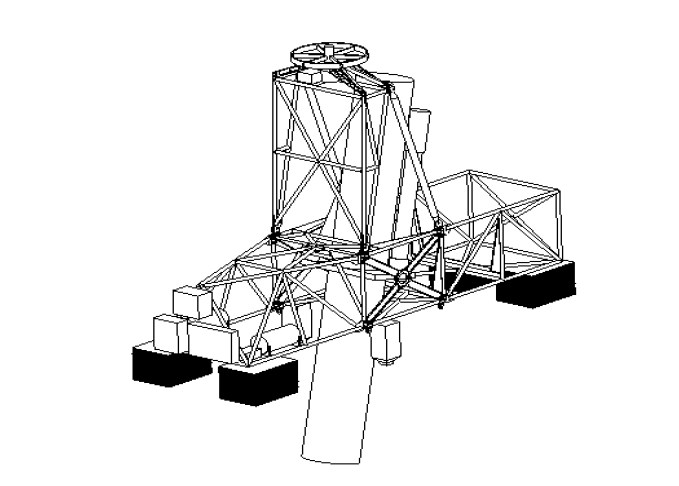
HERO was an X-Ray telescope and the first one aimed to obtain focused images of astronomical X-ray sources at hard X-ray energies (20-75 keV).
The key component (the hard X-ray optics) are full-shell electroformed-nickel-replicated (ENR) mirrors coated with iridium to enhance high-energy reflectivity. As the critical grazing angle for reflection varies approximately inversely with energy, these mirrors employ smaller angles than their low-energy counterparts and consequently have smaller diameters and collecting areas per shell. The mirrors have a 6 meter focal length.
To exploit the full potential of the HERO optics necessitates a balloon gondola that can provide commensurate pointing accuracy, stability, and pointing knowledge. The HERO gondola utilizes a coarse aspect system for slewing based on a differential global positioning system (GPS) and a fine inertial-mode pointing system that uses a novel day/night aspect camera system to update onboard gyroscopes. The total payload dimensions are 25 feet long, 6.5 ft wide and 16 ft high.
Details of the balloon flight
Balloon launched on: 5/27/2007
Launch site: Scientific Flight Balloon Facility, Fort Sumner, (NM), US
Balloon launched by: Columbia Scientific Balloon Facility (CSBF)
Balloon manufacturer/size/composition: Zero Pressure Balloon Raven - 39.570.000 cu ft - (0.8 Mil.)
Flight identification number: 569N
End of flight (L for landing time, W for last contact, otherwise termination time): 5/28/2007 at 19:40 utc
Balloon flight duration (F: time at float only, otherwise total flight time in d:days / h:hours or m:minutes - ): 26 h
Landing site: Near the New Mexico Arizona border, USA
Payload weight: 3220 lbs
Overall weight: 5500 lbs
The instrument performed very well. The scientific team managed to made during the flight 4 observations of galactic x-ray sources and one observation of an extragalactic source.
External references
- HERO website Marshall Space Flight Center, NASA
- The Development of Hard-X-Ray Optics at MSFC Proc. SPIE Vol. 4851, p. 631-638, X-Ray and Gamma-Ray Telescopes and Instruments for Astronomy
- The HERO Program, high-energy replicated optics for a hard-x-ray balloon payload Proc. SPIE Vol. 3765, p. 816-821, EUV, X-Ray, and Gamma-Ray Instrumentation for Astronomy X
- The Universe Through the Looking Glass Hypography - Science for everyone
Images of the mission


2655If you consider this website interesting or useful, you can help me to keep it up and running with a small donation to cover the operational costs. Just the equivalent of the price of a cup of coffee helps a lot.
About StratoCat
Some Statistics
+ 20 articles from different contributors
+ 15486 balloon launch records already published
+ 15766 balloon launch records in the full database
StratoCat is a non-profit, educational and informative website created, developed and programmed by Luis E. Pacheco. It is based on an idea first conceived by the author in 2001 and is online since September 17th, 2005.
This website is an independent initiative, and thus is not endorsed, supported or have any relationship with any governmental or private agency or company in the balloon field.
Page generated on 15-May-2024 - 06:59:10pm  © StratoCat 2005~2024 - All Rights Reserved.