
Purpose of the flight and payload description

The ANITA instrument is a radio telescope to detect ultra-high energy cosmic-ray neutrinos from a scientific balloon flying over the continent of Antarctica. It will be the first NASA observatory for neutrinos of any kind.
Neutrinos are of great interest to astrophysicist as they are the only particle that can reach earth unattenuated at all energies. This is particularly of interest at high energies where other particles and photons will interact with the photons of the microwave background making them unable to propagate and survive over long astrophysical distances. In other words, if the scientists want to see the ultra-high energy universe, they should view it through the "light" of neutrinos.
The ANITA instrument detects these ultra-high energy neutrinos by use of the Askaryan effect. This effect predicts the production of a coherent radio emission from the cascade of particles produced in a high-energy particle interaction. In other words detecting a 'snap' in the radio frequencies caused by the interaction of the ultra-high energy neutrino.
In order to detect this radio emission (Askaryan pulses) it's needed a radio transparent medium for the interaction to occur in - and lots of it since these interactions are rare. Some materials that are radio transparent are salt, sand and ice. Also needs a fairly radio quiet area as the Askaryan pulses are very faint signals.
The ANITA instrument is being designed to fly over the continent of Antarctica - the location of some of the most pure ice in the world as well as one of the most radio quiet spots on earth. Flying at 120,000ft (~ 37 km) the instrument can observe ~1.5 million square kilometers of ice. However Neutrinos are so rare that with a detection area that large the scientists don't expect to see more than a hundred or so events.
Details of the balloon flight

Balloon launched on: 8/28/2005 at 15:15
Launch site: Scientific Flight Balloon Facility, Fort Sumner, (NM), US
Balloon launched by: National Scientific Balloon Facility (NSBF)
Balloon manufacturer/size/composition: Zero Pressure Balloon Raven - 29.470.000 cuft - (0.8 Mil)
Balloon serial number: W 29.47-2X-48
Flight identification number: 547N
End of flight (L for landing time, W for last contact, otherwise termination time): 8/28/2005 at 13:44
Balloon flight duration (F: time at float only, otherwise total flight time in d:days / h:hours or m:minutes - ): 4 h 13 m
Landing site: 58 miles W southwest of Fort Sumner, NM, USA
Payload weight: 2360 lbs
Overall weight: 4189 lbs
The launch (by dynamic method using launch vehicle) was complished at 9:15 MST
After a nominal ascent phase with the balloon heading east, a float altitude of 127.100 ft was attained at 11:31 MST and the balloon started a slow drift due west (click in the map at left to see the balloon flight path).
At 12:44 MST, after 4 hours of stable flight, due to higher than expected upper winds and thunderstorms in the landing area the cutdown command was sent.
The payload touched ground at 13:28 MST in an open field, 58 miles west southwest of Fort Sumner (34-18.7 N / 105 - 23.9 W).
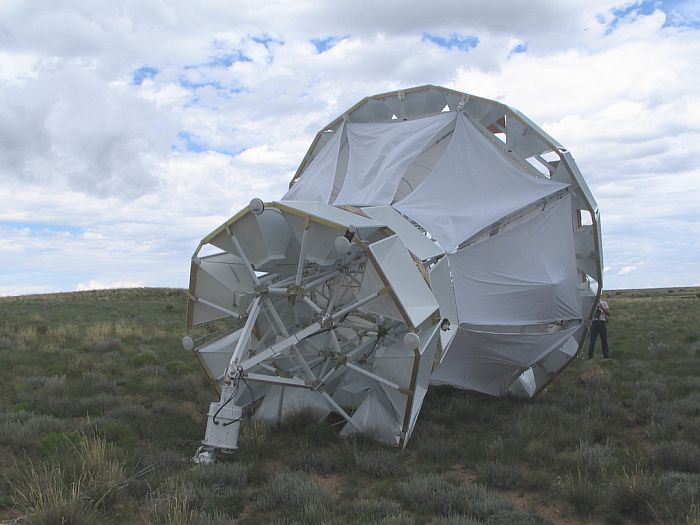
The payload tipped over on its side after parachute separation but however no damage was suffered.
This was the Engineering Test Flight of the full scale gondola with all subsystems represented and two antennas only mounted on the frame to limit landing damage.
During the flight the 8m tall Gondola performed perfectly but no science data obtained due to electromagnetic interference coming from an Air Force Base nearby (Cannon AFB in Clovis). The waveform recording system worked well.
External references
- ANITA website University of Hawaii (Mauna Loa)
- Constraints on Cosmic Neutrino Fluxes from the ANITA Experiment Phys.Rev.Lett. 96 (2006) 171101
- Status of ANITA and ANITA-lite Proceedings of International School of Cosmic Ray Astrophysics, 14th Course: "Neutrinos and Explosive Events in the Universe", Erice, Italy, 2-13 July 2004
Images of the mission


703If you consider this website interesting or useful, you can help me to keep it up and running with a small donation to cover the operational costs. Just the equivalent of the price of a cup of coffee helps a lot.
About StratoCat
Some Statistics
+ 20 articles from different contributors
+ 15490 balloon launch records already published
+ 15769 balloon launch records in the full database
StratoCat is a non-profit, educational and informative website created, developed and programmed by Luis E. Pacheco. It is based on an idea first conceived by the author in 2001 and is online since September 17th, 2005.
This website is an independent initiative, and thus is not endorsed, supported or have any relationship with any governmental or private agency or company in the balloon field.
Page generated on 19-May-2024 - 07:07:23am  © StratoCat 2005~2024 - All Rights Reserved.