
Purpose of the flight and payload description
Sometime before a balloon campaign starts at Esrange every year is launched a balloon to test their technique and logistics systems. The students at Kiruna's different space related educations are offered the opportunity to send their own designed and built experiments with the balloon. The students are from the space engineering programmes at the Department of Space Science and from the technical high school programs.
Students from different years and courses are involved in the project, which means that different groups of students meet and get a chance to work together on the basis of their respective areas of competence. It is the students themselves who lead, design and build the experiments and the instruments destined for the balloon launch.
Most of the data to be collected during the balloon flight is used later in the courses.
This was the second flight of the project and involved the participation of students at Kiruna Space and Environment Campus togheter with pupils from Hjalmar Lundboms school and the space high school, Rymdgymnasiet and also the collaboration from the University of Copenhagen.
Details of the balloon flight
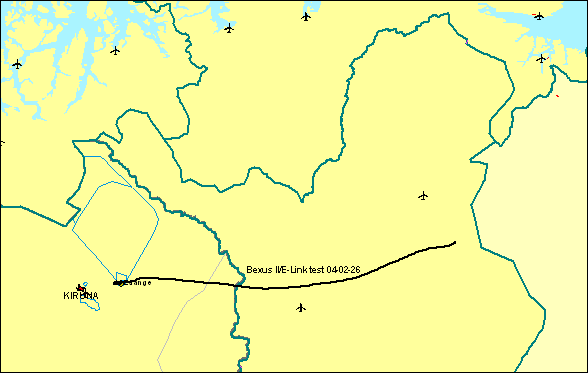
Balloon launched on: 2/26/2004 at 10:57
Launch site: European Space Range, Kiruna, Sweden
Balloon launched by: Swedish Space Corporation (SSC)
Balloon manufacturer/size/composition: Zero Pressure Balloon 10.000 m3
End of flight (L for landing time, W for last contact, otherwise termination time): 2/26/2004 at 15:40
Balloon flight duration (F: time at float only, otherwise total flight time in d:days / h:hours or m:minutes - ): 5 h 6 m
Landing site: In the northeast part of Finland, near the Russian border
Campaign: BEXUS
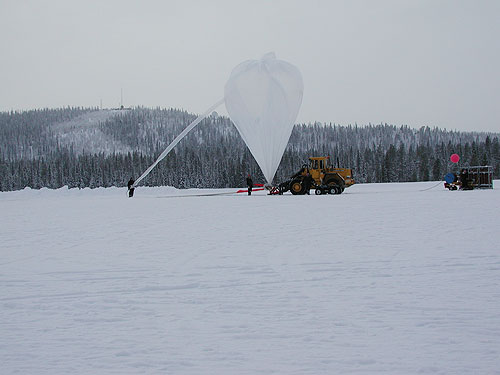
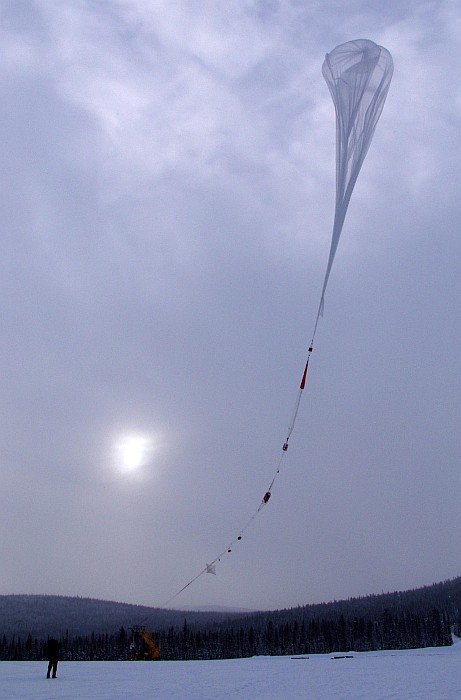
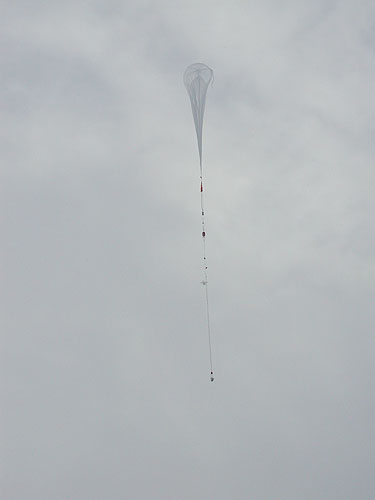
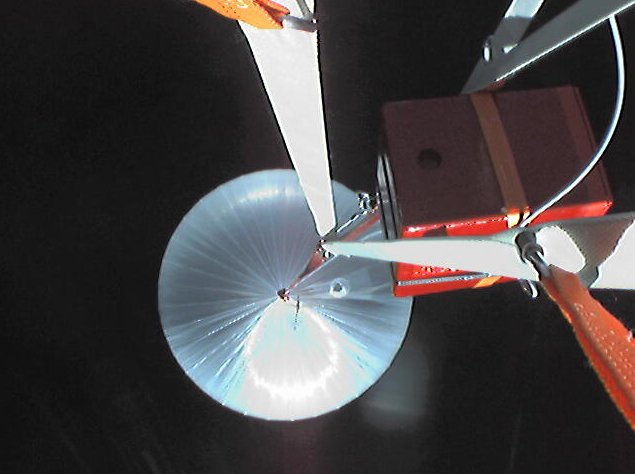
The balloon was successfully launched at 11:57 UTC on Febraury 26th and reached a float altitude of 27,6 km at 13:30 utc.
After a flight of near 5 hours due to east, the cut down command was given and the landing took place in the Northern Part of Finland near the Russian border.
The experiences performed in this second flight were:
Student's Gondolas
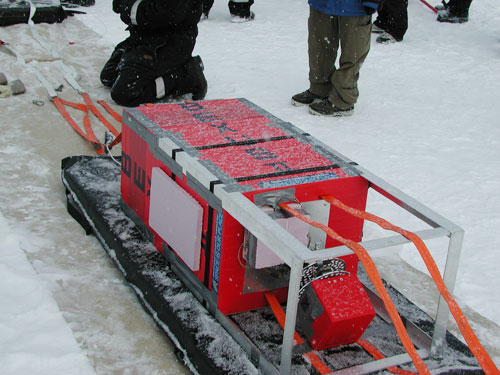
The main plataform called BEXUS II provides support to the rest of experiences. It includes: high definition sampling of analogue signals, serial platform bus for handling of commands and data between ground station and the experiments, GPS-system localization and time, power switching, measuring and distribution, power supply with batteries and a ground station segment for monitoring and controling the BEUXS II platform and experiments.
The experiments to be performed were:
VHI (verification of harddrive integrity) to evaluate the use of a hard drive to store data. This would then eliminate the use of a radio link for experiments that produces large amounts of data.
Chemical Power High Altitude Experiment to study the behavior of Fuel cells and Zinc-air batteries under different atmospheric conditions.
GAMMA-RAY PROJECT that used a Geiger Mueller tube with a good time resolution to detect Gamma Ray Bursts.
BASS (Bexus Active Stabilizer System) a platform which will stabilize a camera.
The project "solar panels" to test how much power 4 different solar cells deliver depending on temperature, pressure and amount of light.
NAC (Narrow Angle Camera) originally designed for an European satellite project to take pictures in flight by remote command.
G-spot to measure the attitude of the balloon and its payload as well as the shocks during lift-off and landing with 8 accelerometers.
HEAL (2-Hour Extreme Altitude Life-analysis) were organism called tardigrades will be sent up with the balloon to be exposed to the extreme environments that can be found along the journey to investigate how the environment has affected its DNA.
Esrange Gondola
Test of the E-Link system with maximum data load versus achieved flight range.
External references
- BEXUS project website Department of Space Science, Umeå university och Luleå university of technology
- Department of Space Science Luleå University of Technology
- List of balloons launched from ESRANGE SSC Space website (via Archive.Org)
Images of the mission
1422If you consider this website interesting or useful, you can help me to keep it up and running with a small donation to cover the operational costs. Just the equivalent of the price of a cup of coffee helps a lot.
About StratoCat
Some Statistics
+ 20 articles from different contributors
+ 15486 balloon launch records already published
+ 15766 balloon launch records in the full database
StratoCat is a non-profit, educational and informative website created, developed and programmed by Luis E. Pacheco. It is based on an idea first conceived by the author in 2001 and is online since September 17th, 2005.
This website is an independent initiative, and thus is not endorsed, supported or have any relationship with any governmental or private agency or company in the balloon field.
Page generated on 15-May-2024 - 06:59:10pm  © StratoCat 2005~2024 - All Rights Reserved.