
Purpose of the flight and payload description
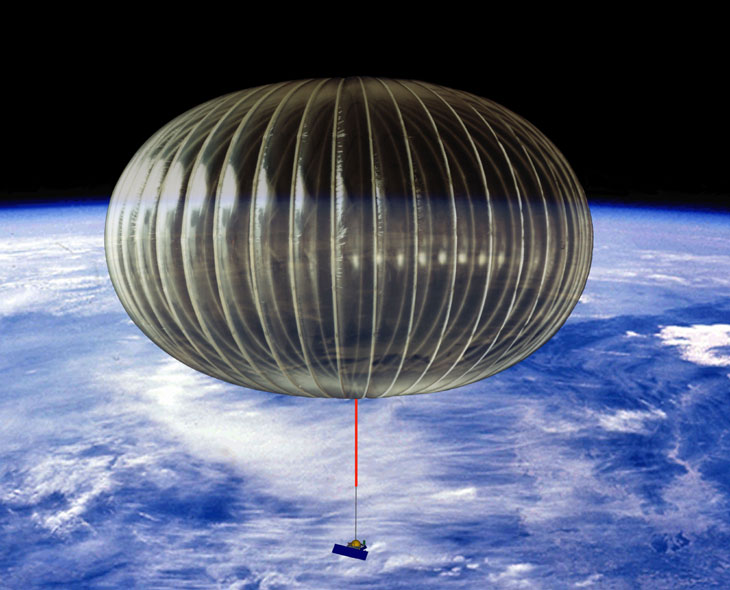
A project to develope a balloon system capable of providing scientific measurements for 100-day missions with floating altitude close to 35km transporting payloads of near 1.5 tons.
It is a super-pressure balloon made of a composite fabric (polyester + polyethylene film and fabric) that is filled with Helium and hermetically sealed. Meridional tendons provide additional rigidity to the envelope. The pressure inside the envelop is maintained above the ambient pressure at all times to keep the balloon afloat at a constant altitude. During daytime the internal pressure increases due to solar heating but the volume remains constant due to the rigidity of the envelope. At night the pressure drops due to infrared radiative cooling to space, but as long as the internal pressure remains above the ambient pressure, the balloon stays at the same altitude.
On the future, transported by stratospheric winds around the globe at 30m/s the ULDB would be make a full circunnavegation to Earth in about 2 weeks.
Details of the balloon flight
Balloon launched on: 5/26/2001 at 13:38 utc
Launch site: Scientific Flight Balloon Facility, Fort Sumner, (NM), US
Balloon launched by: National Scientific Balloon Facility (NSBF)
Balloon manufacturer/size/composition: Zero Pressure Balloon 110.000 m3 - SF3-4.001-.8/.8-NA
Balloon serial number: R4.00-1-14
Flight identification number: 498N
End of flight (L for landing time, W for last contact, otherwise termination time): 5/27/2001 at 17:58 utc
Balloon flight duration (F: time at float only, otherwise total flight time in d:days / h:hours or m:minutes - ): 28 h
Landing site: 10 miles NW of Gila Bend, Arizona, US
The ULDB ballooncraft attached to a zero-pressure balloon was launched using the dynamic launch method from Ft Sumner, NM.
The ballooncraft was recovered in excellent condition after a flight of 28 hours but the radiometers were destroyed at impact.
In this technological flight the payload consisted of a small platform carrying an Eppley pyrgeometer and a modified Eppley pyranometer attached to the bottom of the ballooncraft.
The instruments had an unobstructed hemispherical view of the upwelling radiative field.
The ballooncraft was recovered in excellent condition but the radiometers were destroyed at impact.
External references
- Broad Band Radiometry Project web site at NASA Langley Center No longer available - copy of the page stored at Archive.Org
Images of the mission

675If you consider this website interesting or useful, you can help me to keep it up and running with a small donation to cover the operational costs. Just the equivalent of the price of a cup of coffee helps a lot.
About StratoCat
Some Statistics
+ 20 articles from different contributors
+ 15490 balloon launch records already published
+ 15769 balloon launch records in the full database
StratoCat is a non-profit, educational and informative website created, developed and programmed by Luis E. Pacheco. It is based on an idea first conceived by the author in 2001 and is online since September 17th, 2005.
This website is an independent initiative, and thus is not endorsed, supported or have any relationship with any governmental or private agency or company in the balloon field.
Page generated on 19-May-2024 - 07:07:23am  © StratoCat 2005~2024 - All Rights Reserved.