
For this campaign, the Universidade Estadual Paulista "Julio de Mesquita Filho", counting on the available facilities in the Instituto de Pesquisas Meteorológicas (IPMet) located in the outskirts of the city of Baurú in the Sao Paulo state, Brasil, and the scientific support of the Instituto de Fisica Teórica (IFT), provided the means for launch 3 balloons and the successful recovery of all the scientific instruments. This early experience allowed to collect important data of cosmic rays flows and gamma rays, as well as of the ozone concentration and the earth's electric field terrestrial, but still more important revealed the need for a permanent balloon launch base for this kind of activities. That was the birth of the GLB.
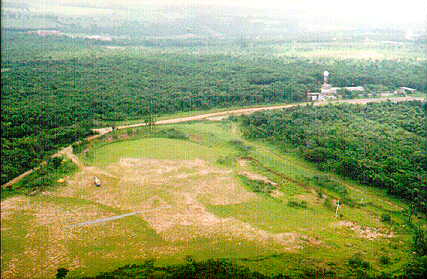
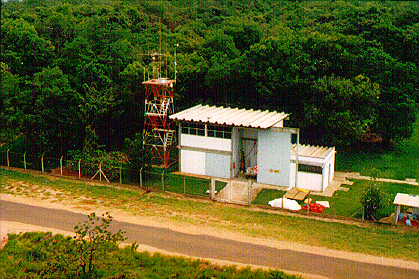
Soon, in 1993 and thanks to the resources granted by the UNESP and Fundación de Amparo a la Investigación do Estado de São Paulo-FAPESP, was built the main infrastructure consisting in a operations building (image at right) and the launch area (image at left). Later, were added devices for the handling of the ballloons and positioning systems, as well as telemetry and telecommunications systems for they pursuit and recovery.
In 1995 the activities of the GLB started through an agreement established with the Service of Aeronomy of the French Centre National of Recherche Scientifique (CNRS), allowing the accomplishment of the Ozono'95 campaign. By 1997, along with the CNRS and with the participation of different international scientific organizations, a new campaign named SRS (Stratospheric Regular Soundings) was made consolidating the operational qualification of the GLB base in the intertropical region.
Since then, different projects on atmospheric research had been developed using balloons launched from there, mainly through agreements of cooperation with the French space agency (CNES) like the one performed in 2000 (SWWS 2000), 2001 (Pre Hibiscus), 2003 (Envisat Pre-Hibiscus) and 2004 (Hibiscus - Troccinox), all involving local flights as well as long duration ones.
During the international campaigns the GLB had the support of the local airport on issues related to aerial security, and a helicopter of the Brazilian Air Force to recover the scientific payloads as soon as posible.
In mid-2000s, and after the retirement of its head researcher Dr. Bui Van Ngan André, the GLB ceased to exist as an operating group within the structure of IPMET. The building that once served for the integration of payloads and material collection operations nowadays is home to the "Observatorio Astronómico didático Lionel José Andriatto".
The disarticulation of the GLB however did not mean the end of the activity with balloons there. Almost eight years after the last campaign, a new scientific initiative used again the weeded area adjacent to IPMET to make several flights of small-sized balloons. This launches were part of a study of the tropical area called TRO-PICO focused on analyzing the impact of tropical convection overshooting in the stratospheric moisture balance at both local and wide scales.
The initiative carried out by several research institutes and universities from France performed more than thirty balloon flights between 2012 and 2013.
Table of balloons launched from IPMET, Baurú
| Date | Hour | Flight Duration | Experiment | Payload landing place or cause of the failure |
|---|---|---|---|---|
| 5/12/1971 | 15:10 utc | 4 h 44 m | X-RAY DETECTOR | Chacara, Minas Gerais, Brazil |
| 6/2/1978 | 09:00 | 2 h | TECHNOLOGICAL FLIGHT | In Arthur Nogueira, Sao Paulo, Brazil |
| 6/4/1978 | 6:00 local | 5 h | OLINDA (Observações de Linhas Nucleares Da Atmosfera) | In Cambuí, Minas Gerais, Brazil |
| 4/22/1989 | --- | CHARGED PARTICLES DETECTOR | --- No Data --- | |
| 11/??/1991 | 18 h | COSMIC RAYS, OZONE AND ELECTRIC FIELD DETECTORS | --- No Data --- | |
| 11/8/1991 | 21:09 utc | 18 h | MEASUREMENTS OF X-RAYS IN THE ATMOSPHERE, CHARGED PARTICLES AND NEUTRONS; PROTONS AND GAMMA RAYS; ULTRA HIGH ENERGY EXOTIC PARTICLES FLUX. | --- No Data --- |
| 11/10/1991 | 18 h | dE/dX DETECTOR | --- No Data --- | |
| 11/22/1995 | V | --- | SAOZ (Systeme d'Analyse par Observation Zenithale) | --- No Data --- |
| 11/23/1995 | V | --- | SAOZ (Systeme d'Analyse par Observation Zenithale) | --- No Data --- |
| 11/23/1997 | 18:00 | 2 h 3 m | LABS (Laser Backscatter Sonde) / OPC (Optical Particle Counter). | --- No Data --- |
| 11/26/1997 | 18:00 | 2 h 2 m | LABS (Laser Backscatter Sonde) / OPC (Optical Particle Counter). | --- No Data --- |
| 11/29/1997 | V | --- | SAOZ (Systeme d'Analyse par Observation Zenithale) + SAOZ-BrO | --- No Data --- |
| 11/17/2000 | 22:24 | 18 d | SAMBA gondola | Payload lost. |
| 11/19/2000 | 23:33 | 22 d | SAMBA + INMARSAT | Payload lost. |
| 2/13/2001 | 21:38 | 39 d | SAOZ (Systeme d'Analyse par Observation Zenithale) + RUMBA | 30 kms from La Estrella, Salta, Argentina |
| 2/15/2001 | 22:20 | 71 d | SAMBA + INMARSAT | Payload lost. |
| 2/15/2001 | 19:55 | 4 h | SAOZ (Systeme d'Analyse par Observation Zenithale) | Mirante do Paranapanema, Sao Paulo, Brazil |
| 2/21/2001 | 20:03 | 4 h 30 m | SAOZ BrO (Systeme d'Analyse par Observation Zenithale) + µLIDAR + H2O | Cuiaba Paulista, Sao Paulo, Brazil |
| 2/21/2001 | 21:55 | --- | SAMBA + RUMBA + LABS (Laser Backscatter Sonde) | --- No Data --- |
| 2/18/2003 | 22:00 | --- | SAOZ (Systeme d'Analyse par Observation Zenithale) + NARCISSE TEST | 15 km NE from Bauru where a team was sent for recovery and investigations. SAOZ payload seems to be only slightly damaged. |
| 2/18/2003 | A | --- | SAOZ + SAOZ-H2O + DIRAC + H2O/O3 | --- No Data --- |
| 2/19/2003 | V | 3 h 30 m | DIRAC CFCs/SLS + µLIDAR + Descartes CFCs/SLS + O3 SSS/H2O SAW | 30 kms E of Assis, Sao Paulo, Brazil |
| 2/20/2003 | 23:00 | 10 d | SAOZ-H2O (Systeme d'Analyse par Observation Zenithale) + NARCISSE + RADIOMETER | In a small mountain area S of Townsville. |
| 2/22/2003 | 22:00 | --- | INMARSAT EC-TRACK + RUMBA-H2O/O3 + RUMBA VORCORE-TURBULENCE | 10 km from Bauru, Sao Paulo, Brazil |
| 2/23/2003 | 23:00 | 8 d | MIR (Montgolfier Infra-Rouge) | Payload lost in the ocean. |
| 2/23/2003 | 20:20 | --- | SAOZ + SAOZ/BrO + DIRAC + µLIDAR + O3 SSS + H2O SAW | --- No Data --- |
| 1/31/2004 | 18:30 local | 2 h 10 m | SAOZ (Systeme d'Analyse par Observation Zenithale) + SAOZ-BrO + LABS backscatter diode laser | In a sugar cane field in Paraguaçu Paulista located 100 km from launch site. |
| 2/4/2004 | 21:46 | --- | SAOZ (Systeme d'Analyse par Observation Zenithale) + IR RADIOMETER | Somewhere near the NW Australian coast. |
| 2/5/2004 | 20:00 | --- | SAOZ + SAOZ-BrO + DIRAC | 80 km W from launch site. |
| 2/6/2004 | 15:00 | ~ 13 d | RUMBA + TURBULENCE | On the Pacific Ocean (22.34º S - 149.65º W) |
| 2/10/2004 | 00:45 | --- | BACKSCATTER SONDE | --- No Data --- |
| 2/12/2004 | 20:37 | 53 d | RUMBA + TURBULENCE | 60 kms W of the town of Franklin, Queensland, Australia |
| 2/12/2004 | 00:00 | --- | BACKSCATTER SONDE | --- No Data --- |
| 2/12/2004 | 16:15 | 1 d | RUMBA + O3/H2O | On Brazil territory (21.09º S - 50.97º W) |
| 2/13/2004 | 22:35 | --- | BACKSCATTER SONDE | --- No Data --- |
| 2/13/2004 | 18:20 local | 4 h 25 m | DESCARTES + µLIDAR + µDIRAC + O3 SSS + H2O SAW + µSDLA | 90 km N of Bauru, Brazil |
| 2/13/2004 | 13:00 | --- | NILU CUBE | 80 km N of Bauru, Sao Paulo, Brazil |
| 2/16/2004 | 00:00 | --- | BACKSCATTER SONDE | --- No Data --- |
| 2/16/2004 | 18:25 local | 7 h 21 m | DESCARTES + LABS + AIRS + µDIRAC + O3 SSS + H2O SAW + TDLAS | Near the Parana state border, Brazil |
| 2/17/2004 | 00:00 | --- | BACKSCATTER SONDE | --- No Data --- |
| 2/19/2004 | 00:00 | --- | BACKSCATTER SONDE | --- No Data --- |
| 2/21/2004 | 22:30 | --- | BACKSCATTER SONDE | --- No Data --- |
| 2/21/2004 | 00:00 | --- | BACKSCATTER SONDE | --- No Data --- |
| 2/23/2004 | 22:30 | --- | BACKSCATTER SONDE | --- No Data --- |
| 2/24/2004 | 22:30 | --- | BACKSCATTER SONDE | --- No Data --- |
| 2/24/2004 | 18:00 local | ~ 4 h | µDIRAC + µLIDAR + µSDLA + O3 SSS + H2O SAW + AIRS | 150 kms. SE of Bauru, Brazil |
| 2/25/2004 | 15:07 | --- | NILU CUBE | 40 kms. S of Baurú. |
| 2/26/2004 | 20:00 | --- | DESCARTES + µDIRAC + LABS + O3 SSS + H2O SAW + TDLAS | --- No Data --- |
| 2/26/2004 | 23:00 | 39 d | SAOZ (Systeme d'Analyse par Observation Zenithale) + IR RADIOMETER + LIGHTING/BLUE JET SENSOR | On the Pacific Ocean (9.16º S - 210º W) |
| 2/29/2004 | 16:00 | 80 d | TECHNOLOGICAL FLIGHT | In Madagascar Island |
| 3/3/2004 | 00:30 | 30 m | µLIDAR | A few kilometers NE of Baurú |
| 3/6/2004 | 15:45 | 39 d | OZONE AND WATER VAPOUR SENSORS | In Antarctica (74º S - 88º E) |
| 3/7/2004 | 12:00 | 56 d | TURBULENCE SENSOR | On the Indian Ocean south (56.4º S - 56.2º E) |
| 3/9/2004 | 21:00 | 27 d | OZONE AND WATER VAPOUR SENSORS | In Antarctica (77º S - 127º W) |
| 3/10/2004 | 21:35 | 9 d | µLIDAR | In the Western Pacific half way between New-Caledonia and Fiji |
| 3/11/2004 | 21:00 | 37 d | TECHNOLOGICAL FLIGHT | In the Antarctic Sea (58º S - 151º W) |
| 3/4/2012 | 23:35 utc | --- | FLASH-B + COBALD | --- No Data --- |
| 3/9/2012 | 23:40 utc | --- | FLASH-B + COBALD | --- No Data --- |
| 3/9/2012 | 22:50 utc | --- | Pico-SDLA (Spectromètre à Diode Laser Accordable) | --- No Data --- |
| 3/11/2012 | 22:18 utc | --- | Pico-SDLA (Spectromètre à Diode Laser Accordable) + LOAC | --- No Data --- |
| 3/11/2012 | 21:30 utc | --- | MINI-SAOZ (Systeme d'Analyse par Observation Zenithale) | --- No Data --- |
| 3/13/2012 | 22:03 utc | --- | Pico-SDLA (Spectromètre à Diode Laser Accordable) + LOAC | --- No Data --- |
| 3/13/2012 | 23:39 utc | --- | FLASH-B + COBALD | --- No Data --- |
| 3/14/2012 | 21:59 utc | --- | Pico-SDLA (Spectromètre à Diode Laser Accordable) CH4 | --- No Data --- |
| 3/15/2012 | 1:27 utc | --- | FLASH-B + COBALD | --- No Data --- |
| 3/15/2012 | --- | JETWATCH + FEMTOLIDAR | --- No Data --- | |
| 3/16/2012 | 5:11 utc | --- | FLASH-B + COBALD | --- No Data --- |
| 3/16/2012 | 21:30 utc | --- | MINI-SAOZ (Systeme d'Analyse par Observation Zenithale) | --- No Data --- |
| 3/16/2012 | 23:40 utc | --- | FLASH-B + COBALD | --- No Data --- |
| 11/21/2012 | 21:00 utc | --- | Pico-SDLA (Spectromètre à Diode Laser Accordable) | --- No Data --- |
| 12/4/2012 | 20:45 utc | --- | Pico-SDLA (Spectromètre à Diode Laser Accordable) | --- No Data --- |
| 12/14/2012 | --- | Pico-SDLA (Spectromètre à Diode Laser Accordable) H2O | --- No Data --- | |
| 12/20/2012 | --- | Pico-SDLA (Spectromètre à Diode Laser Accordable) H2O | --- No Data --- | |
| 1/18/2013 | --- | Pico-SDLA (Spectromètre à Diode Laser Accordable) CH4 + H2O | --- No Data --- | |
| 1/25/2013 | --- | FLASH-B + COBALD | --- No Data --- | |
| 1/26/2013 | --- | Pico-SDLA (Spectromètre à Diode Laser Accordable) H2O + LOAC | --- No Data --- | |
| 1/27/2013 | 22:41 utc | --- | FLASH-B + COBALD | --- No Data --- |
| 1/28/2013 | 11:50 utc | --- | Pico-SDLA (Spectromètre à Diode Laser Accordable) H2O | --- No Data --- |
| 1/29/2013 | --- | Pico-SDLA (Spectromètre à Diode Laser Accordable) CH4 (TEST) | --- No Data --- | |
| 1/30/2013 | --- | COBALD | --- No Data --- | |
| 1/31/2013 | --- | Pico-SDLA (Spectromètre à Diode Laser Accordable) CH4 + H2O | --- No Data --- | |
| 2/1/2013 | --- | Pico-SDLA (Spectromètre à Diode Laser Accordable) H2O | --- No Data --- | |
| 2/1/2013 | --- | FLASH-B + COBALD | --- No Data --- | |
| 2/4/2013 | --- | Pico-SDLA (Spectromètre à Diode Laser Accordable) CH4 + H2O | --- No Data --- | |
| 2/5/2013 | --- | FLASH-B + COBALD | --- No Data --- | |
| 2/6/2013 | --- | Pico-SDLA (Spectromètre à Diode Laser Accordable) H2O + LOAC | --- No Data --- | |
| 2/7/2013 | --- | FLASH-B + COBALD | --- No Data --- | |
| 2/9/2013 | --- | FLASH-B + COBALD | --- No Data --- | |
| 2/10/2013 | --- | Pico-SDLA (Spectromètre à Diode Laser Accordable) CH4 + H2O | --- No Data --- | |
| 2/11/2013 | --- | FLASH-B + COBALD + LOAC | --- No Data --- | |
| 2/11/2013 | --- | Pico-SDLA (Spectromètre à Diode Laser Accordable) CH4 + H2O | --- No Data --- |
If you consider this website interesting or useful, you can help me to keep it up and running with a small donation to cover the operational costs. Just the equivalent of the price of a cup of coffee helps a lot.